Joshua Habursky isn’t just defending premium cigars from regulation—he’s taking the fight to ski resorts, building university programs, and rewriting the industry playbook one smoke-filled room at a time.
The Room Where It Happened
Joshua Habursky‘s career pivot happened in a Washington, D.C., cigar lounge. Not in a boardroom, not in a congressional office, but at Shelly’s Back Room—the legendary spot that has witnessed countless political deals and life-altering decisions.
Fresh out of undergrad at Washington & Jefferson College, Habursky had his future mapped out: He would become a political science professor, wear pinstripe suits, smoke cigars, and teach a new generation about politics. He’d been accepted to graduate programs—a full ride to the University of Georgia, a nice scholarship to Penn State. Everything was on track.
Then came the award. Habursky had won recognition through the American Association of Political Consultants and traveled to D.C. to accept it. After the ceremony, he found himself at Shelly’s Back Room, cigar in hand, surrounded by the political operatives, lobbyists, and power brokers who made things happen in the nation’s capital.
“I had a cigar, I had an amazing time,” he says. “Just met a bunch of people, and I’m like, You know what? I need to be at the epicenter of it. If you’re playing in the major leagues, you’ve got to be in D.C. for politics. You know, it’s New York for finance, L.A. for Hollywood.”
That night changed everything. He pivoted from his academic trajectory, applied to Georgetown for his master’s degree, and moved to Washington. Shelly’s had shown him a different path—one where cigars weren’t just an accessory to intellectual conversation, but a language of power, connection, and deal-making.
From Erie to the Epicenter
Habursky’s journey with cigars began in a small liberal arts college outside Pittsburgh. His political science professor, who would become his mentor, hosted what he calls “an ad hoc Winston Churchill society”—weekly cigar sessions where they’d discuss politics.
“I wanted to be a political science professor, like this guy was my hero,” Habursky says. “It was like the pinstripe suits, the cigar, the swagger. I’m like, when I grow up, I want to be this guy.”
His first cigar? A Java Mint at Mike Ditka’s restaurant in Pittsburgh, after wrapping up work on political campaigns. “I don’t smoke flavored cigars now, but that was the first cigar that I remember,” he says. From that moment, cigars became intertwined with his political ambitions.
Unlike many in Miami’s Cuban-American cigar culture where premium tobacco is part of daily life, Habursky came to cigars as an outsider. Growing up in Erie, Pennsylvania, cigars weren’t part of his family tradition. “Neither of my parents were cigar enthusiasts. You know, my grandparents weren’t. It was never commonplace,” he explains. But that college experience opened a door that would eventually define his career.
The Path to PCA
After Georgetown, Habursky built his career in lobbying—first with the American Motorcyclist Association, then the American Diabetes Association, and finally the Community Bankers Association, where he led grassroots advocacy efforts that helped roll back Dodd-Frank financial regulations.
That big win gave him leverage. He could choose his next move. Around the same time, his friend Dan Trope was working as director of federal affairs at IPCPR (now Premium Cigar Association). Habursky saw an opportunity.
“Dan, you need to start doing some grassroots. Grassroots is my specialty,” he told him. That conversation led to a year-long consulting gig building what is now Cigar Action, PCA’s grassroots advocacy arm. When Trope left to work for Swisher, Habursky took his job as director of federal affairs, eventually rising to CEO.
“There’s no price that you can put on any other job,” he says. “I truly believe that I have the coolest job in the world. To be an ambassador for the cigar industry—spreading the positive message of premium cigars, not only here in the United States, but elsewhere internationally.”
Playing Offense
Habursky’s vision for PCA goes beyond defending the industry from regulations. He wants to go on offense.
“We don’t always need to be defensive,” he says. “I think we found a strong point in the luxury lifestyle. This is a simple luxury, much like a $50 bottle of bourbon. Anybody can enjoy this, but it is a luxury.”
His strategy? Pop-up cigar installations in unexpected places. Imagine: Aspen during ski season, a PCA lounge paired with a champagne company. “You’re going to find a whole new adult audience that, oh, you know what? I have a couple hours before I go down the ski slopes. I’m going to enjoy a cigar with a glass of champagne.”
He’s eyeing 25 markets, partnering with luxury brands—watch companies, coffee houses, beach clubs. “If you go to Miami, you have watch companies that have pop-up installations, you have illy Coffee or Lavazza pop-ups. We can do the same with premium cigars.”
The association isn’t just connecting retailers with manufacturers—it’s facilitating entire experiences, bringing spirits associations into the mix, putting their logos on elegant setups that introduce cigars to people who might never walk into a traditional cigar shop.
The Battle for Distinction
But the offensive push doesn’t mean abandoning defense. Premium cigars face an existential challenge: being lumped in with cigarettes, vapes, and other tobacco products that bear little resemblance to a hand-rolled cigar.
“This isn’t big cigarette,” Habursky emphasizes. “This is a very niche industry. When you peel back the curtain and look at the time, the effort that goes into making a premium cigar, looking at the data and the research—it’s completely different.”
His three-pronged strategy: exemptions carved out for premium cigars in legislation, better economic and health data to correct misconceptions, and litigation as a backup plan. California has been particularly challenging, implementing emergency regulations that skirted public input.
But PCA, alongside Cigar Rights of America and manufacturers, has filed lawsuits challenging these regulations.
“That’s kind of the beauty of this country,” he says. “Even after you lost in the legislative sphere, you almost get a second chance” in the courts.
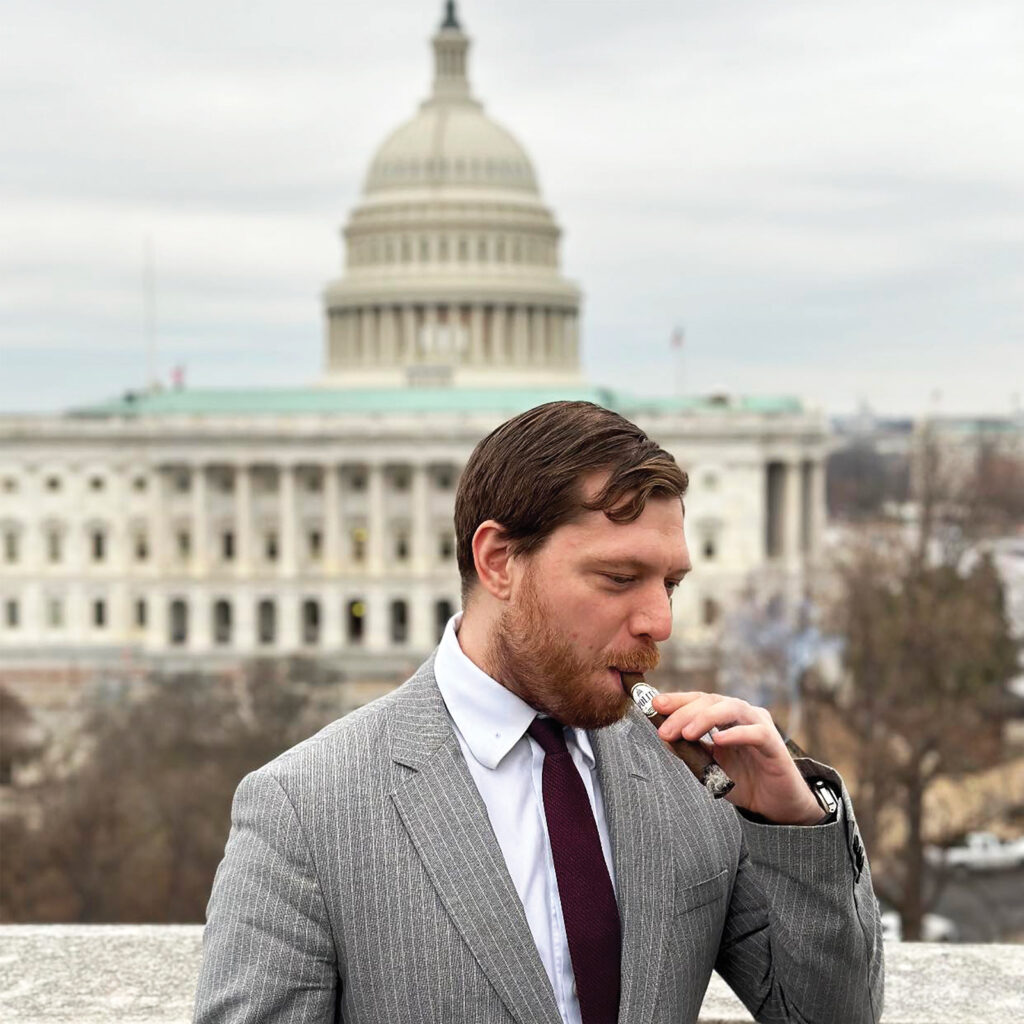
Meanwhile, he’s building bridges in Congress. The Congressional Cigar Caucus now has 60 members. Some smoke cigars in their offices in the Capitol. Quarterly events on the Speaker of the House’s balcony feature industry stalwarts like Carlito Fuente and Rocky Patel, allowing lawmakers to hear firsthand stories from family businesses, not big tobacco corporations.
Tariffs and Threats
When tariffs on Nicaraguan imports threatened the industry, Habursky’s message was clear and strategic: “Our brick-and-mortar retailers are American businesses. These are 3,500 plus American small businesses. 50,000 American jobs are at stake.”
His argument doesn’t focus on Nicaragua’s cigar factories, despite their importance. It centers on Main Street America. “The tobacco in the terroir and the region and the nuances of it in Nicaragua cannot be replicated here in the United States. The businesses are based in the United States. So these tariffs, in the most punitive sense, would hurt American businesses the most.”
PCA moved quickly, submitting economic research to federal dockets, working with economists from the University of Nebraska to model the devastating effects. A 20% drop in sales, rising prices, lost state and local tax revenue. All competing associations—despite their differences—united on the issue.
“We’re all together in this,” Habursky says. “That’s kind of refreshing, and hopefully a model that we can move forward with.”
Professionalizing the Industry
Perhaps Habursky’s boldest move is the FIU Luxury Marketing Masterclass—the first accredited university program focused on premium cigars.
“If we really want to take it to the next level, we need to work with an accredited institution,” he explains. The three-day intensive course at Florida International University’s School of Hospitality sold out immediately and is already renewed for 2026.
The program is built for people who want to understand the craft, how cigars are made, how to taste them, and how the industry works. It brings together industry experts, readings, tastings, and there’s a final exam. Graduates receive a certificate signed by the dean. It’s designed for people who want to advance in the premium cigar space, including assistant managers aiming for leadership roles or sales reps targeting leadership positions.
Before pitching FIU, Habursky did his homework, taking courses on cheese, chocolate, wine, and luxury fashion at various universities. “Look, if people can get enrollment for a cheese class,” he reasoned, “and universities are doing cannabis courses or beer-making courses, with the premium cigar sector and Miami, this is a natural fit.”
More courses are planned: pairings with spirits and coffee, agricultural programs in Nicaragua and the Dominican Republic, business and financial courses through MBA programs. On a personal note, he’s now pursuing his Doctorate in Business Administration at FIU, focusing his dissertation on highly regulated products.
The Culture Keeper
For all his strategic thinking and political maneuvering, Habursky remains a consumer first. He visits cigar lounges unannounced while traveling, seeking the organic experience without revealing his position.
“It’s fascinating how this simple product connects people,” he marvels. “You can walk into a store where you’re the only one that looks the way you do, and you get welcomed, because we have this one thing in common.”
His late-night cigars are sacred. Around 10 or 11 p.m., that’s his cigar for himself. “My best thoughts, my ideas for new initiatives come surrounded by cigars,” he says. He’s even built a private cigar lounge in his parents’ basement in Erie—a four-person bunker surrounded by historical firearms, books, and bourbon.
The PCA office in Washington functions as a working cigar lounge. Domino tables, members smoking and talking politics—a microcosm of the 3,500 cigar lounges across America where people from all walks of life, all income levels, all backgrounds come together.
“Everyone in this room is significantly over 21 years old. You’re playing dominoes, you’re smoking cigars, and you’re talking politics,” he explains to visiting lawmakers. “You can go to our member stores and have that same experience.”
Five Years to Make a Mark
Habursky is under no illusions about the challenges ahead. He fought for the CEO position, and he wants no other job. But he’s realistic about what he can accomplish.
“I have five years to make my mark and reshape the cigar industry so it can handle the challenges for the next 25 to 50 years,” he says. “I’m not an ideas guy just for the sake of ideas. When we set our sights on something, we’re going to take it across the finish line no matter what.”
The FIU program? People talked about it for 10 years before PCA delivered. The Dubai trade show? Discussed for 20 years before it happened. Under Habursky’s leadership, talking stops and execution begins.
His motivation goes beyond professional success. “If I’m fortunate enough to have a family, I want my son or daughter to have the ability when they’re 21 years of age to choose whether or not to have a cigar, or maybe if they’re in business, to open up a cigar lounge.”
Back in his office, cigar smoke drifts toward the ceiling as another meeting wraps up. Someone’s about to roll through for a half-hour conversation. Dominoes clack on the table in the corner. It looks like a lounge, feels like a lounge, but make no mistake—this is command central for an industry under siege and on the move.
That night at Shelly’s Back Room changed Habursky’s trajectory from academia to advocacy. Now he’s determined to change the trajectory of an entire industry—one smoke-filled room at a time.