14% ABV
Still Red Wine
Gaiole in Chianti, Tuscany, Italy
The Blueprint for Chianti
The name Chianti has been attached to red wine from this stretch of hill country between Florence and Siena for centuries. For much of the 20th century, Chianti was known as the wine that came in the straw-wrapped bottle at the Italian restaurant. The straw bottle is long gone, but the Chianti name still carries some baggage. Chianti Classico was born of that reputation. Since 1996, Chianti Classico, a formally delineated zone in the region’s historic heart, has been designated its own DOCG. It is one of the many confusing elements of Italian wine for non-Italian consumers, but know that the Chianti Classico designation is the real thing — the original, historic territory that earned Chianti its reputation before the name was applied more broadly.
Within that zone, the Gran Selezione designation sits at the top of the quality pyramid. Introduced in 2014, it is reserved for single-vineyard wines or selections of the very best barrels from an estate, aged a minimum of 30 months before release. It was created specifically to establish a tier of Chianti Classico that could stand alongside the finest single-vineyard wines anywhere in the world, and in the decade since its introduction, it has done exactly that. Critics who spent years dismissing Chianti as an also-ran to Barolo or Brunello have been pulling back those opinions one spectacular Gran Selezione at a time.
Almost 900 Years at the Same Address
The Ricasoli family has been documented at Brolio Castle since 1141. That is not a typo. The estate predates most of the institutions, governments, and nations that shaped the modern world, and it has been producing wine under the same family name for the better part of that entire run. According to Family Business Magazine, Barone Ricasoli is the fourth-longest-lived family company in the world and the oldest winery in Italy. It is the kind of history that could easily become a distraction, a marketing narrative leaned on in place of quality. In the case of Ricasoli, the history is accompanied by the wines that back it up.
The family’s most consequential contribution to Italian wine came in 1872, when Baron Bettino Ricasoli — who had already served as the second Prime Minister of a newly unified Italy — published the results of decades of research into what the ideal blend for Chianti should be. His formula, built around the primacy of Sangiovese, became the legal and philosophical foundation of the appellation and accelerated a wholesale shift in how Tuscan growers thought about their vineyards. Before Bettino’s work, French varieties were widely planted across the region. His research gave producers both the evidence and the permission to pull them out and replant with native grapes, Sangiovese chief among them — a decision that shaped Italian wine for the next 150 years.
Pairing by: Erik Calviño
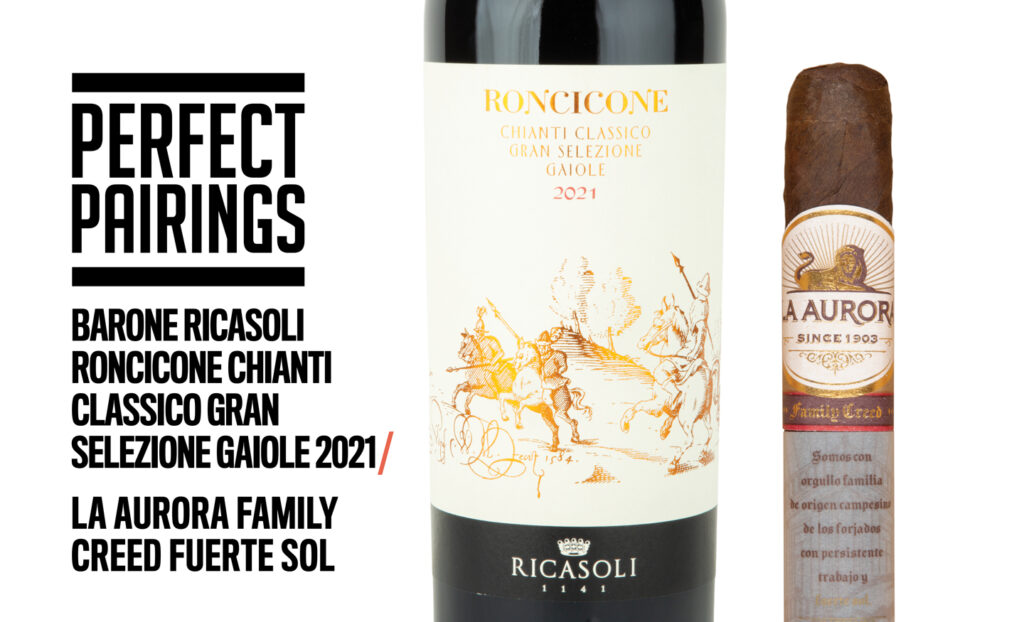
Tasting Notes: Barone Ricasoli Roncicone Chianti Classico Gran Selezione Gaiole 2021
In Chianti Classico, 2021 was an exceptional year, producing numerous highly rated expressions. The Roncicone Gran Selezione Gaiole is no exception, scoring 97+ in Wine Advocate.
The nose presents a combination of minerality and earth, balanced by red fruit and rose petals that evolve as the wine airs out. It’s the sort of wine that you keep smelling because it is so layered. On the palate, the acidity and ripe tannins complement the rich, juicy fruit. It is ready to drink right now, but stocking a few bottles away for a few years may result in something legendary.
Cigar Pairing: La Aurora Family Creed Fuerte Sol
La Aurora Family Creed Fuerte Sol is an award-winning blend from La Aurora. It scored 92 points and landed the #15 spot in the Top 25 Cigars of 2025 list. The cigar’s smooth combination of pepper, earth, and toasted almond incorporates the wine’s ripe fruit sweetness effortlessly. After a few sips and puffs, the two start to feel inseparable. For its part, the wine’s structure and acidity help to hold it up to the cigar’s strength and body.