15% ABV
Red Wine
Valpolicella Classica, Veneto, Italy
The Most Labor-Intensive Wine in Italy
There are wines made with care and wines made with obsession. Amarone della Valpolicella belongs firmly in the second category. The producers employ a winemaking technique called appassimento that has no equivalent anywhere else in the fine wine world. To understand what makes Amarone special, you have to start there.
After the autumn harvest in the hills northwest of Verona, the best clusters of Corvina, Corvinone, Rondinella, and Oseleta grapes are not pressed like in every other region. Instead, they are laid out on traditional bamboo racks called arele in large, well-ventilated lofts above the winery and left to dry for roughly 100 days. During that time, the grapes slowly dry. As water evaporates, sugars and aromas concentrate, and the bunches lose between 30 and 40 percent of their original weight. The grapes that went in plump and fresh come out shriveled and almost raisin-like. It takes almost five pounds of dried fruit to produce a single bottle of Amarone as opposed to roughly three pounds in most other red wines.
In January, the dried grapes are pressed, and the grape must begins a long, slow fermentation that can last a month or more. The resulting wine is dry; all the concentrated sugar is fermented out, leaving a wine of enormous richness and structure that is nonetheless bone dry. It then spends a minimum of three years aging in large Slavonian oak casks before release. The entire process, from harvest to bottle, takes the better part of five years. No shortcuts exist. Appassimento, which has roots dating back to ancient Rome, is done either fully and patiently or not at all.
Four Generations in Valpolicella
In 1902, Giacomo Tommasi purchased a small parcel of land called the Rafaèl vineyard in Pedemonte, a village in the heart of the Valpolicella Classica zone. He was not yet producing Amarone, but he was building the foundation of what would become one of the most respected wine estates in northeastern Italy. The family gained full ownership of the property by the second generation, and in 1959, produced the first official vintage of Tommasi Amarone Classico. That bottle changed the trajectory of the family business entirely.
The fourth generation took over key roles in 1997 and accelerated the estate’s growth while maintaining its original commitment to excellence. They farm only their own grapes, a discipline that keeps quality within the family’s control. Their two flagship Valpolicella vineyards are La Groletta, a south-facing hillside site close to Lake Garda known for structure and bold fruit character, and Conca d’Oro, the Golden Shell, a terraced vineyard whose limestone-rich soils contribute a mineral precision that lifts the wine. The Amarone Classico is sourced from both.
To mark the winery’s 110th anniversary in 2012, the family built a dedicated aging cellar for its Amarone wines. Its centerpiece is a barrel they call the Magnifica; at 33,000 liters, it is the largest working wine barrel in the world.
It is partly a statement of ambition and partly a symbol of how seriously the Tommasi family takes the traditions it has spent four generations protecting. The estate now farms over 800 hectares across Italy and exports to more than 85 countries, but the Amarone Classico remains the wine that defines it.
Pairing by: Erik Calviño
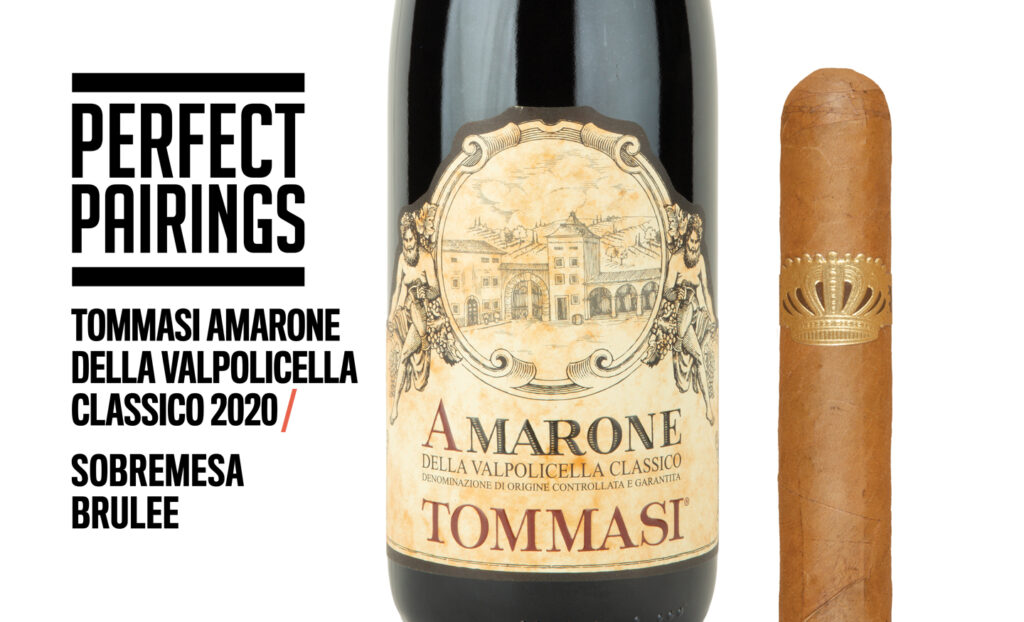
Tasting Notes: Tommasi Amarone della Valpolicella Classico 2020
The 2020 Tommasi Amarone is intensely deep ruby in color. The nose exhibits ripe black cherry, licorice, and spice. The palate is full and juicy with flavors of plum, cherries, and a touch of cocoa. Tannins are firm but refined, with balanced acidity, and a long, dry, cedary finish.
Cigar Pairing: Sobremesa Brûlée
Pairing the 2020 Tommasi Amarone with the Sobremesa Brûlée is a natural match from the first puff. The wine slots into the Sobremesa Brûlée’s profile flawlessly, adding a mouthwatering, juicy fruit element to the cigar’s creamy combination of pepper, roasted nuts, and smooth pepper.