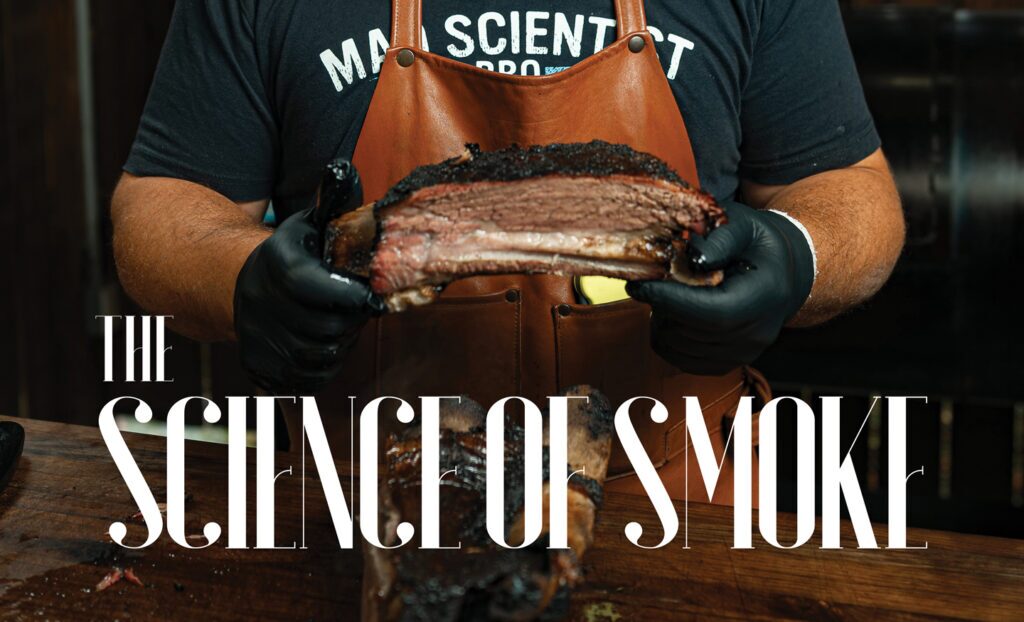
From Amish roots to barbecue fame, Jeremy Yoder built a massive following by treating brisket like biochemistry. Now he’s bringing that same curiosity to the world of premium cigars.
Smoke, Science, and Serenity
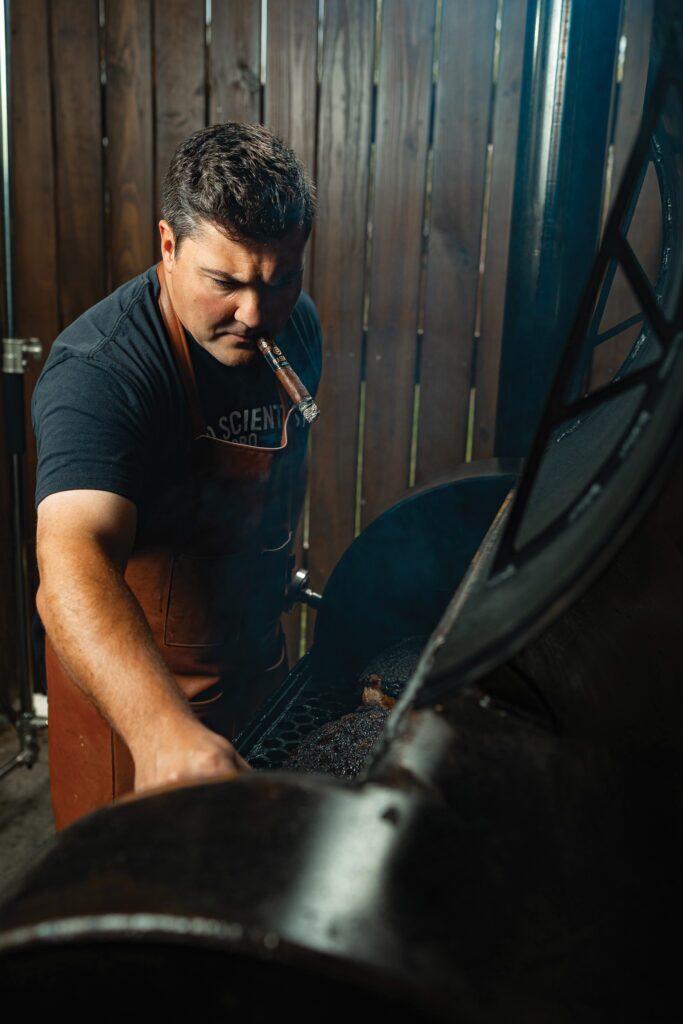
The smell of wood and Nicaraguan tobacco, both burning, mingle in the late-afternoon air. Jeremy Yoder stands near a large offset smoker, watching a thin blue ribbon of smoke drift from the stack. In a slim-fit black t-shirt, he looks more like a stocky, clean-cut accountant than a pitmaster. Then someone hurls a complicated question about the lignin to cellulose ratio of post oak and everything about him changes. His eyes brighten, smile broadens, he’s back in the classroom and teaching is his superpower. He deftly breaks down complex topics into easily digestible tidbits, pushing your limits of understanding right up to the “aha!” moment, then letting off the gas to let it sink in.
Yoder, the man behind the popular Mad Scientist BBQ YouTube channel, has turned an obsession with heat and chemistry into a full-time career. His close to 1 million YouTube subscribers tune in not for flashy showmanship but for foundational understanding. He explains collagen breakdown with the ease and familiarity of someone who has tested and documented every step of the way, with every type of protein—because he has. He diagrams air flow, fat rendering, and smoke particle size as if he’s still in a lab. In a way, he is.
From Amish to Algorithms
Yoder was born in rural Michigan into an Amish family where the rules were clear: no electricity, no cars, no TV, and certainly no Wi-Fi. His parents eventually left the community, and that exit gave Yoder, still in elementary school, his first jolt of technology. Suddenly there were lights, refrigeration, and the hum of a world he’d never known. His fascination with how things worked never left—except when it comes to technology itself, which remains somewhat mysterious to him.
There’s a certain poetry in the contrast. Here’s a man whose livelihood now depends on algorithms and data transfer rates, yet everything that defines him is analog—the smell of burning wood, the sound of fire drawing air, the feel of smoke density between his fingers. His world revolves around nature’s oldest forces—heat, air, wood, and time—yet his career flourished in one of the most modern ecosystems imaginable: YouTube. It’s as if a blacksmith stumbled into Silicon Valley and found out the forge still matters.
A Teacher Learns to Burn
Yoder grew up mostly in Kentucky, where curiosity turned into academia. He earned a biochemistry degree, convinced he’d go to medical school—until a summer spent shadowing doctors changed his world view. “The doctors I followed around were mostly miserable,” he recalls. “They’d done very well for themselves—nice house, nice car—but they were markedly unhappy. I thought, ‘I don’t know that this is what I thought it was.'”
Instead of medical school, Yoder moved to Los Angeles to study ancient languages—Hebrew and Greek—while teaching to pay the bills. His classroom was in a small private school of about 50 students in Woodland Hills, catering to the children of the rich and famous.
“I loved the kids,” he says. “Loved seeing their eyes light up when they understood something. But I hated the job.” Kids were getting picked up in Maseratis and Ferraris while he was struggling to pay his rent. “I’m going home that night and telling my wife, hey, we may have to pay rent on the third this month.”
He needed an outlet—something to build with his hands and his senses. One weekend he bought what he thought was the ultimate grill, a shiny three-in-one contraption with a little smoker box on the side. “I bought what I thought was the Rolls Royce of smokers,” he says. “I thought, ‘this is the Mount Everest of grills. There’s nowhere to go from here.’ Turns out I was completely wrong.”
That little hardware-store grill did more than sear a few steaks—it was a stepping stone into the barbecue rabbit hole. One cook led to another, then another, each one raising more questions than it answered. Before long, Yoder wasn’t just making dinner; he had found a calling.
When the Fire Got Real
In 2018, Yoder left teaching and launched a small catering business. He’d do pop-ups at breweries, partnering with Pocock Brewing Co. for monthly events. “It was starting to go really well,” he says. “[I] started to have kind of upscale clients who were hiring me for stuff.”
But Yoder and his wife, Erica, had already started something else: making videos. “My wife is very creative,” he explains. “She’s interested in video and film and editing—all those things.” They created Mad Scientist BBQ and began posting whenever they could squeeze it in between catering gigs. Erica filmed and edited while Yoder handled the barbecue and the explanations. But consistency was a challenge—weekends spent serving barbecue meant long gaps between video uploads.

Then came March 2020. When Los Angeles went into lockdown, the catering business evaporated overnight. “My wife was six months pregnant at the time,” he says. “I realized pretty quickly that making $0 was not a sustainable plan for our future.”
But what looked like a crisis became an opportunity. Stuck at home with no events to cater, they took advantage of the time and filmed as many videos as they could—sometimes posting twice a week. The consistency paid off. That summer, Mad Scientist BBQ hit 100,000 subscribers. They moved back to Kentucky where the cost of living was lower and Yoder’s roots ran deeper. By year’s end, they were able to go full-time with YouTube.
“She’s kind of the unsung hero of Mad Scientist BBQ,” he says about Erica, “because without her, no videos are getting made.”
The Gospel of Smoke
To Yoder, barbecue isn’t about recipes. It’s about understanding processes—the physics of heat transfer, the chemistry of fat rendering, the biology of connective tissue. “If you only know ‘do this, then this, then this,’ when one thing changes, you’re stuck,” he explains. “But if you understand how a thing works, you can adjust to different circumstances.”
He approaches wood selection the same way. “A lot of people think you must use post oak, and the reason behind it is because Aaron Franklin uses post oak,” he notes. The influence of Franklin, a barbecue master and owner of Franklin Barbecue in Austin, is undeniable—he’s “like barbecue Jesus,” Yoder jokes. “Because he uses post oak, people think they must therefore use post oak from now until eternity.”
But Yoder has tested this assumption extensively. “How you run the fire is far more important than the specific variety of wood,” he says. His personal favorite? Pecan. “I think it balances the right level of sweetness and smokiness with the color that you get on the meat.”
Cigars: The Other Smoke
When the last brisket’s sliced and the crowd goes home, Yoder reaches for something slower: a cigar.
“It’s a guaranteed period of 60 or 90 minutes where I am at peace,” he says. “Usually I like to unplug. It’s like a hard reset for my brain.” Whatever he might be anxious about or depressed about, thoughts running through his head—he gets to unplug from all that.
Cigars have been part of his life since he was 18, living in Lexington, Kentucky. That first handmade cigar was a Quorum, and it opened his eyes to what premium tobacco could be. Over the years, cigars became his meditation—one stick a week while sitting in the park, completely disconnecting.
“One of the coolest things I learned in Nicaragua was how many hands go into producing each one of these cigars,” he explains. “It’s a lot of work, and it’s much appreciated.”

The Blend: Mad Scientist Cigars
That respect eventually turned into collaboration. Yoder met Terence Riley of Aganorsa Leaf, and the two began building a cigar that mirrored his barbecue style—balanced, bold, and deliberate.
“Terence basically broke down how we could do it—there are essentially three ways,” Yoder explains. “One is, I tell him cigars I love from other producers, and they could make their own blend. The second way is you smoke the Aganorsa products, and we start with one of those you really like, and we adjust from there. And the third and most difficult option is to start from scratch.”
Yoder took a hybrid approach. “I told him the box-pressed Anniversario was my favorite. I also really like the Anniversario Maduro.” He then received several blends, smoked them, gave feedback, took copious notes, and worked with Riley iteratively. “We kind of homed in on, okay, this is the wrapper, binder and filler combination that is exactly what I’m after.”
The process humbled him. “I’m not a master blender. I realized that. Getting to Nicaragua and learning everything I didn’t know about cigars taught me, ‘okay, maybe I should trust the people who know what they’re doing on this one.’ ”
Looking back at his 18-year-old self smoking that first Quorum cigar in Lexington, he marvels at the journey. “If you told that kid, hey, someday you’re going to be able to work with some of the best blenders in the world to create your own cigar that will have your name on it? I wouldn’t believe you.”
Full Circle
Ask Yoder what ties it all together and he’ll tell you it’s curiosity—the desire to understand what happens beneath the surface, whether it’s collagen or combustion. “I don’t drink,” he says with a grin, “but I get high on information. I love to learn new things—that’s what’s exciting for me.”
He talks about his first trip to Nicaragua the same way he talks about his first successful brisket cook: like a scientist witnessing beauty in the process. Understanding it doesn’t diminish the magic—it enhances it. The more he learned about tobacco farming, fermentation, and blending, the more he appreciated what goes into each cigar.
Back at the offset smoker, the afternoon has cooled into evening. That thin blue ribbon of smoke still drifts skyward—clean, steady, perfect. Yoder takes another draw from his cigar and exhales, adding his own smoke to the mix. Two different fires, two different fuels, but the same fundamental process: transformation through heat and time.
Fire. Patience. Craft.