Kansas City offers a look at America’s 250-year journey from a young nation pushing westward to a global power. Two landmark museums tell that story through the First World War and the presidency of Harry Truman.
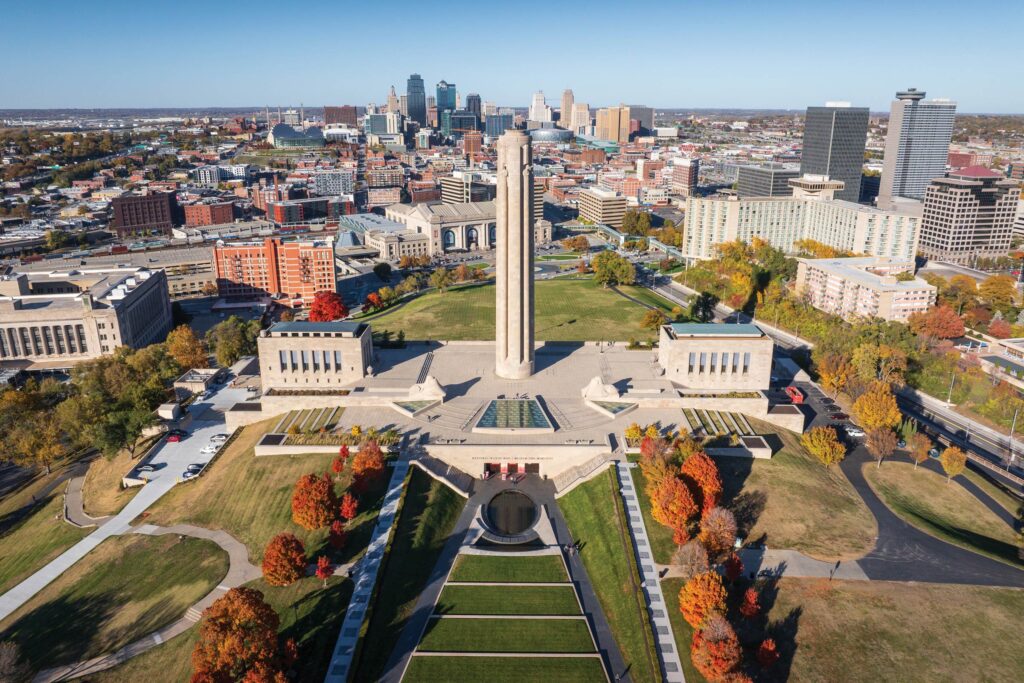
Photo credit: Kevin / Adobe Stock
Kansas City, Mo. – We posed the question to a docent at the National WWI Museum and Memorial here: Why is it called the Great War?
“Well, I don’t know but I would imagine it was because it was the first world war,” he said unconvincingly.
He’s in good company. No one knows precisely why it remains the Great War. H.G. Wells optimistically called it the “the war that will end war.” German biologist Ernst Haeckel called it the “first world war” in September 1914, contending it was bigger than just a European war.
But did anyone really call it the Great War, or is that the domain of armchair historians?
Whatever the origin, a trip to the 47-acre National WWI Museum and Memorial is a patriotic journey to honor our nation’s 250th anniversary.
The setting for the museum is a swath of mid-city land, backing up to a bluff that features a panoramic view to the north and an endless sky above. The 217-foot-tall Liberty Memorial Tower is set on a wide plaza amid a smaller hall and sculptures.
The museum entrance takes visitors over a glass bridge where they can watch a brief primer on the war. The video touches on tensions in Europe in the early 1910s and the war’s beginning with the 1914 assassination of Austrian Archduke Franz Ferdinand.
The war was integral to who and what America was at the time, coming on the heels of the Industrial Revolution. The U.S. was just a 138-year-old baby compared to the other large players — Germany, Russia, Great Britain, France — whose roots as nations, empires, or kingdoms stretched back centuries.
The U.S. had zero interest in getting absorbed by the drama. President Woodrow Wilson was more interested in keeping a struggling economy afloat.
The exhibits document the unfolding European theater with on-the-ground footage, displays of battleground trenches, weapons, and artifacts, all augmented by well-written blow-by-blow narratives.
The first half of the museum is devoted to pre-U.S. involvement, the years 1914-17, each month presented on wall displays complemented by ephemera and military wares behind glass, providing a steady visual narrative of the age.
The room also features full-size cannons and other maneuverable weapons used, notably with a meager range of three or four miles. Case displays showcase ground arms, uniforms, mess kits and communications gear.
Special attention is given to chemical warfare, which the Germans deployed first during a battle in Belgium. There is a careful dissection of the types of chemicals used, including mustard gas and chlorine. Even the U.S. used it, establishing a Chemical Warfare Service in 1918.
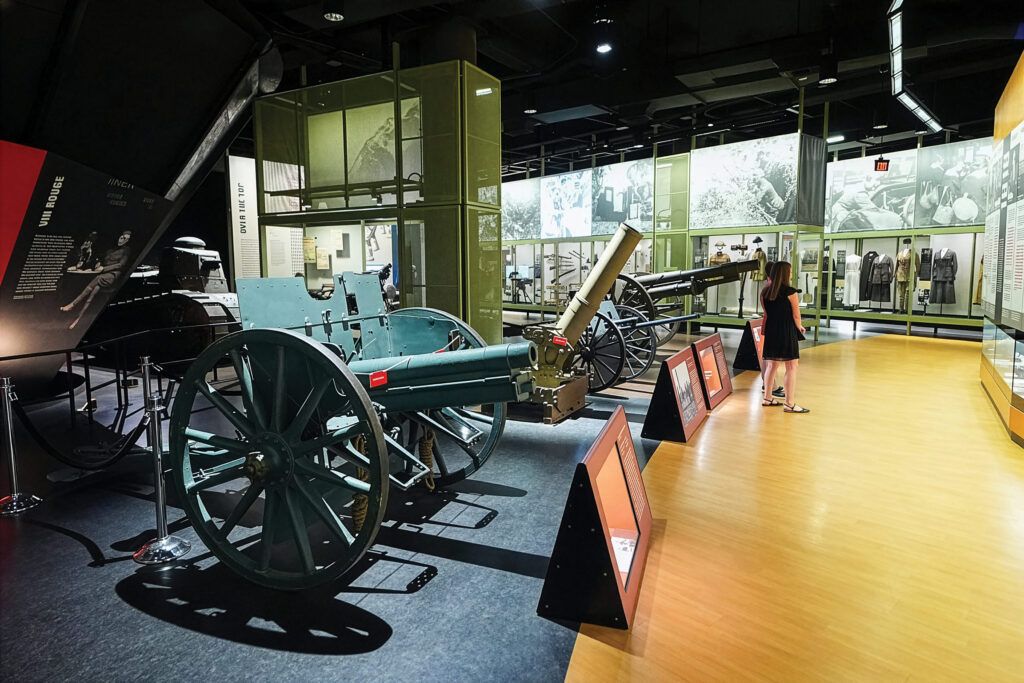
Photo credit : Kansas City Parks and Recreation
WWI was also noted for its reliance on trench warfare, which is as barbaric as it sounds. Troops on both sides dug furrows in the ground with improvised turrets to prop up their rifles, shooting at each other from their embedded positions.
These trenches, which also served as quarters for the infantry, were rough; rain and snow turned them into muddy ravines, filled with sewage and icy water. The space provides models of the trenches, describing how life was for an average soldier and showing, through the models, how primitive the conditions were. It shows the trenches composed of earth, sandbags, timber, wire, and boards, complete with models of soldiers sitting in them, looking miserable and scared.
Woven throughout are uniforms and gear from the field, drawing contrasts of how the various fighting units were organized and outfitted. Germany, with the aid of Austria-Hungary, was by far the favorite in the contest and together they formed what was called the Central Powers. They were joined by the Ottoman Empire, a powerhouse that included countries from the Middle East, southeastern Europe, and North Africa.
It becomes quickly clear that the Central Powers would prevail. Great Britain, France, and Italy, even with some pre-U.S. help, did not have the military might of Germany and its friends.
The only thing Germany feared was U.S. involvement, which is where the second part of the exhibit opens things up.
It is laid out as the first part of the museum, with a month-by-month account of the growing tensions, starting in 1917. The U.S. was already irritated by several attacks on ships with American passengers, turning domestic opinion against Germany.
The real catalyst to entering the war, though, was the Zimmermann Telegram, a secret German diplomatic message sent to Mexico in January 1917. It promised to help Mexico regain territories lost in the Mexican-American War in exchange for an alliance. It also asked that Mexico beseech Japan to join the war against the U.S.
There is a scan of the telegram – the original is in the National Archives – and it’s simple and plainspoken; Mexico and Germany would “make war together, make peace together,“ with Germany offering “generous financial support.”
Six weeks after declaring war, the U.S. started drafting men between ages 21 and 30. Many of those who were not drafted entered as volunteers. In a show of the patriotic fervor of the era, displays and photos show cheering supporters outside enlistment stations, backing those volunteers and draftees.
There was, of course, resistance to the war, and the curators fairly present those objections as well. Isolationists included German and Irish immigrants, labor activists and political conservatives.
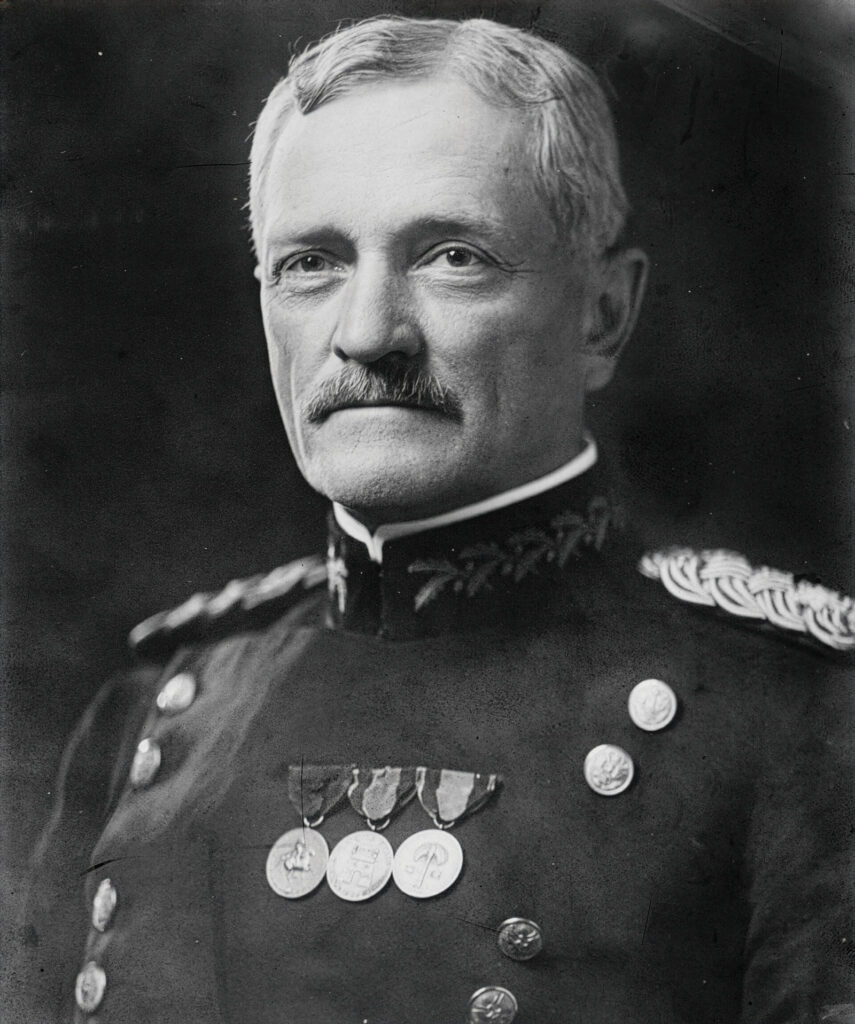
Large, colorful wall diagrams map the U.S. operations in Europe, as nearly 2 million American troops served in Europe during World War I, most of them in France. The mobilization was quick. By November 1918, the U.S. had fully mobilized and was helping end the war, an effort led by Gen. John Pershing.
The commander warrants his own display, with a large photo of Pershing, which notes he was selected to lead the effort in part because of his work commanding the 1916–17 expedition into Mexico. He was fresh off his failed pursuit of Pancho Villa, but there were few serious contestants for the job.
The United States declared war on Germany on April 6, 1917. The armistice ended the fighting on November 11, 1918.
By the end of the visit, we are intellectually exhausted. The displays, the narratives, the footage, the recreations and the weaponry provide a four-hour history lesson that does better than a full term of college could deliver.
But we never learn why it was called the Great War, a contradiction in terms if there ever was one.
It remains, though, a huge part of the nation’s 250 years, establishing the U.S. as a superpower that could, and would, police the world. That sentiment, however, would ebb and flow over the coming years – leaders like Jimmy Carter wanted restraint, while others like Barack Obama sought to gain international favor. But WWI created an undeniable claim of power.
***
On a display at the WWI museum, a U.S. Army captain with the 35th division says, “Vauquois Hill…was nothing but a bog. Mud, mud, mud…At seven o’clock, I was ready to fire but the guns wouldn’t raise high enough…[Battery] E put the tail of one gun in a shell hole and fired several rounds at the extreme elevation in the general direction of Germany.”
The quote came from a 34-year-old Missourian who had been turned down for service at one point for poor eyesight. In fact, he was legally blind in his left eye. He gained admittance to the military by memorizing the eye chart.
U.S. Army Capt. Harry Truman was an American original who became one of the most consequential presidents in history.
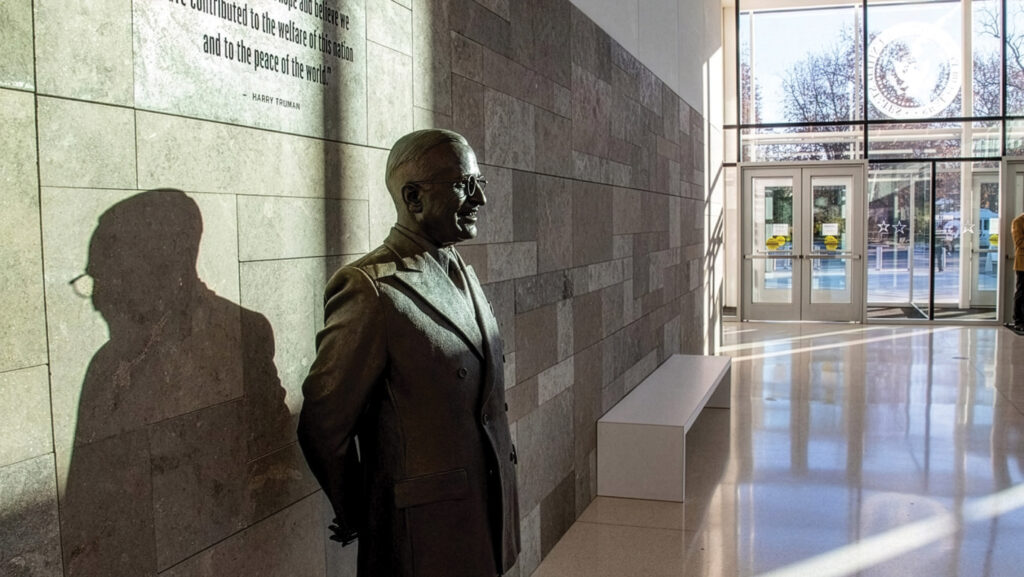
Photo credit : National Archives and Records Administration / Truman Institute
As the only president to hail from Missouri, his legacy is fittingly preserved here in the Kansas City area at the Harry S. Truman Library and Museum.
It is located in the town of Independence, established in 1827 and named in honor of the Declaration of Independence. The Lewis and Clark expedition had passed through the region more than two decades earlier, opening the Missouri River corridor to American exploration and expansion.
When it was incorporated, the town was the farthest west a steamboat could travel up the Missouri River. Travelers disembarked, gathered supplies and moved on toward the promise of a new land.
The country was barely 50 years old. The U.S. was still exploring itself while celebrating its independence.
Like most people on the frontier, the Trumans were farmers.
The museum sits on 13 acres and was established in 1957, the second of the presidential libraries after Franklin D. Roosevelt’s in 1941.
The displays begin with a history of the young Truman: growing up on the prairie, going to school, working as a bank clerk, entering military service, and failing as a clothing merchant.
There is also a good amount of information on the signature accomplishment of his time as a U.S. senator from 1935 to 1945.
Truman chaired the Senate Special Committee to Investigate the National Defense Program, created in March 1941. He led a probe into the money being spent on the war effort. He uncovered massive fraud – some things will never change. The scams his committee uncovered included shoddy quality control among shipbuilders, rampant faked invoices and defective airplane engines that resulted in troop deaths.
It is not noted in the exhibit, but FDR was at the time expanding materiel support for Britain while the U.S. was still officially neutral.
The poorly kept secret overlapped Truman’s investigation into how the enormous American defense buildup was being contracted and administered.
The museum moves quickly to Truman’s defining moment – the death of Roosevelt in April 1945 and the new president’s approval of deploying atomic weapons against Japan.
Among the best of the artifacts is a missive from Secretary of War Henry Stimson to Truman 12 days after the president was sworn in.
“I think it is very important that I should have a talk with you as soon as possible on a highly secret matter,” Stimson said.
The simplicity of the letter does a lot of work. The Manhattan Project must have been its own bomb on Truman. The alternative plan, scheduled for November 1945 with mop-up in March 1946, was a three-pronged invasion of Japan that some estimated would have cost as many as 1 million American lives.
The library doesn’t shy away from the dilemma he faced, the decision he made, or the resulting civilian death toll. Wall-sized photos of the destruction are presented. Japan’s surrender is given plenty of room. It’s a dramatic, extensive exploration of Truman’s first four months in office.
Also noted is Truman’s recognition of Israel as a state, with Truman calling the May 1948 act among the ‘proudest’ of his life.
The narration moves through Truman’s less successful second term. It was marked by the emerging Cold War, anti-communist fervor in the U.S. and a failing economy. By late 1946, prices were up 18% from the previous year. The exhibits are light on the economy, the only weak spot in the museum.
Truman’s second term also included his civil rights endeavors and the Korean War, a conflict in which he bypassed the need for congressional action by declaring America’s involvement a “police action.”
It’s a relief to get to Truman’s return to Independence after 18 years in Washington. The family came home and tried to get back to their old life, which of course was gone forever, in the way fame steals things.
Presidential museums follow an unofficial blueprint, always featuring a recreation of the Oval Office, gifts given to the president and first lady from dignitaries, the presidential limousine, and a blend of newsreel and printed displays. They leave room for personalization, though, and most do it well.
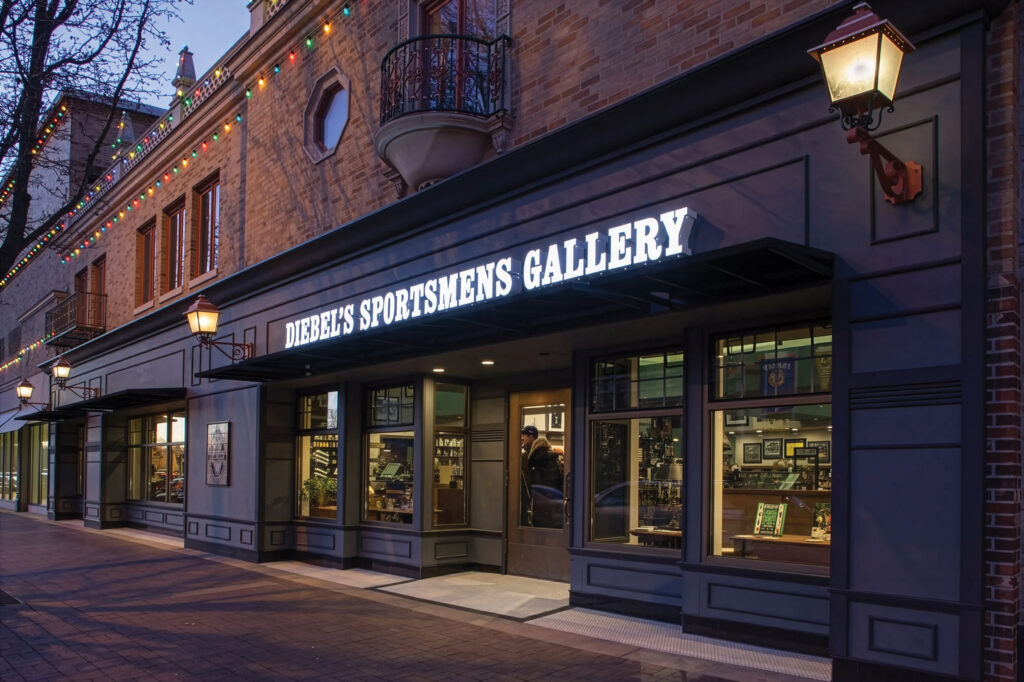
Photo credit: Diebel’s Sportsmens Gallery
In the case of Truman, he was a car guy, which had a whole different meaning in the 1940s and ‘50s. On display are his 1941 Chrysler Royal Club Coupe and first lady Bess Truman’s 1941 Chrysler Windsor sedan, both in mint condition.
The museum wraps up with Truman’s work on his memoirs and his oversight of the site’s development.
The place is configured in an asymmetrical ring around a central courtyard, which features the graves of the Trumans, their daughter Margaret and her husband.
Truman’s life was a checkered path: farmer, soldier, operator who worked the angles of the rough political machine of the Roaring ’20s Kansas City, U.S. senator, twice a wartime president and, finally, a statesman.
He was married for 53 years, enjoyed playing cards and drinking whiskey with his buddies, survived an assassination attempt (it wasn’t even close) and wrote his memoirs for an advance of $250,000 ($3.1 million in today’s dollars).
Throughout the museum, Truman’s succinct, plainspoken aphorisms are posted. He was well developed in the craft of colloquial declarations, and one near the exit is particularly striking.
“Readers of good books, particularly books of biography and history, are preparing themselves for leadership. Not all readers become leaders, but all leaders must be readers.“
This was clearly of its time and has not endured.
***
It is a duty of anyone on a historical trek to discover the best places to find some good tobacco, in the spirit of the pioneers. The Kansas City area has plenty of places to get a good cigar. While local smoking laws, as in most cities, are hardly loose, the cigar lounge scene is alive and well.
Diebel’s Sportsmen’s Gallery is Kansas City’s oldest cigar and tobacco shop with its main location in Country Club Plaza, a shopping/dining/drinking area in the heart of the city.
Fred Diebel founded the shop in 1954, as the city ranked as one of the top 25 most populous cities in the U.S. It was a traditional tobacconist, trading mostly as a pipe-and-tobacco store. When son Curt took over the reins, he pushed it more toward cigars and gifts, a man’s store where wives and girlfriends can come to find exactly the right smoke or present.
The main room is devoted to gifts, accessories and local paraphernalia. Chessboards, barware, knives, wallets, local sports swag, lighters, cutters, books, bags, and clothes, are all tended to by distinguished fellows in ties. It’s a dress code and it is perfectly fitting for the classy place. The humidor is filled with a wide selection of hits and boutique offerings. Events are frequent; “We had a Drew Estate party last night with 150 people,” a salesclerk says.
The sign on the lounge door, just off the main room, says “members only,” but you can buy a cigar and will be invited to smoke on the premises, even encouraged. The staff is among the most welcoming we have seen in some time, which surely accounts for the steady flow of business over the hour we sat and smoked.
Despite a bevy of contemporary corporate stores, Country Club Plaza was built in the 1920s based on Spanish Revival architecture. Looking at the Raphael Hotel and several older-styled apartment and condo buildings across the way, it’s clear that some of that original flavor stuck.
The plaza was also built with the car in mind, and free parking was always in effect, as it is today. There’s plenty of it, ramps, streets, wherever it is, it’s free.
There’s also the free rail, called the KC Streetcar, which connects at the edge of the plaza and runs through all of the city’s top neighborhoods.
Diebel’s also has a location in Leawood, Kansas, south of the city.
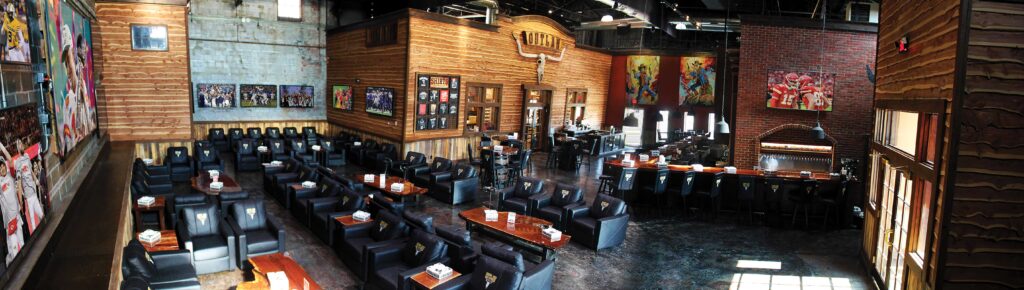
Photo credit: Outlaw Cigar Co
Outlaw Cigar has three locations in the Kansas City area. The one that gets all the attention is Outlaw Brewery and Cigar, an airplane hangar of a spot at 13,000 square feet in North Kansas City, tucked away on a side street in an industrial area. Visitors are greeted with a mammoth viewing room filled with soft leather chairs and a proportionally large bank of 85-inch television screens. A second room features the same, sharing space with a stage that has featured national touring bands.
“I built it out so that inside it feels like Vegas,” says owner Kendall Culbertson. “Or maybe an old western town meets a sportsbook.”
He puts occasional live acts on, but the pull is beer and cigars.
“My philosophy has always been to attract nonsmokers because I know you can create smokers,” he says. He estimates he pulled in up to 100 new smokers a week. “You get a lot of ‘hey we’re here, let’s try it.’ ”
It’s possible; there is a full bar featuring more than 20 of his own brewed beers, and a large humidor with something for everyone. It’s a good form of entrapment; the beer is above average and the cigar selection goes deep.
Culbertson also has an 8,000 square foot lounge in suburban Overland Park, Kansas. The space offers plenty of room for sports watching and draws on the prosperous region’s business clientele.
The walls are filled with trinkets and posters from military outposts all over the world, thanking him for the cigars he sends to deployed service members. They also send him hats, photos and patches, which he proudly slaps on the walls.
“Outlaw Cigar Co., by far is the greatest man cave ever!!” reads one wall hanging from a group of U.S. Marine pilots.
“To Kendall and the good friends at the Outlaw Cigar Company, Thanks for your great support,” from a U.S. Navy captain on the USS Ronald Reagan supercarrier.
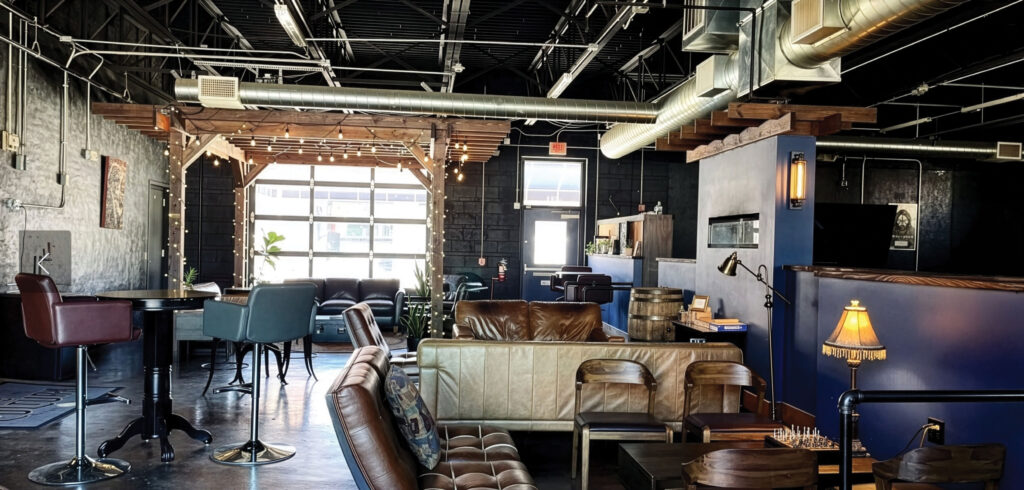
Photo credit: La Cultura Cigar & Social
La Cultura Cigar & Social in Kansas City’s Crossroads Arts District neighborhood looks like it’s been there since the turn of the 20th century, much like the vintage storefronts around it.
It’s in a converted railroad warehouse zone, where La Cultura opened in 2018. The inside resembles an indie music venue from the ‘90s; it’s dark and inviting with an industrial motif – polished concrete floors, exposed ductwork, dark brick walls, some pool tables, dartboards and a couple of weird smells to go with the smoke. It’s a joint with character in the best way, a lived-in place to sit and smoke.
There’s also a small porch outside facing the street, a perfect place to smoke and watch the cars and locals go by. It’s a city feel in a not-quite-developed area, which gives a look at the local flavor.
***
We created a nation-state 250 years ago, bolstered by a spirit proudly displayed in Kansas City. A world war, in which for the first time America flexed a muscle that had taken over a century to hone, is forever enshrined as part of our history at the National WWI Museum and Memorial. The Second World War, with the decisive leadership of our 33rd president, Harry Truman, cemented our country as the world leader, the solver of problems, and an intellectual heavyweight.
Having these two landmark museums in one city is a treasure, landing in the last outpost the frontier ever knew.