14% ABV
Cabernet Sauvignon, Merlot
Bolgheri, Tuscany, Italy
The Rebels Who Changed Italian Wine
Italy’s wine classification system governs everything from which grape varieties can be planted in a given zone to how long a wine must age before release. DOC, DOCG, IGT — the unwieldy acronym hierarchy exists to protect regional identities and consumer expectations, and for the most part it does. But in the 1970s and ’80s, a handful of Tuscan producers decided the rules weren’t serving the wines they wanted to make. So they ignored them.
The wines they produced — made from Cabernet Sauvignon, Merlot, and other varieties with no official standing in Tuscan DOC regulations — could only be labeled Vino da Tavola, or table wine, the lowest designation in the Italian system. What that label didn’t tell you was that some of these table wines were outperforming the finest Bordeaux in international blind tastings. The press gave them a name that stuck: Super Tuscans.
The success of these wines eventually forced the Italian authorities to act; in 1992, the IGT classification — Indicazione Geografica Tipica — was introduced, allowing producers to put a region of origin on the label without being bound by the strict varietal and stylistic rules of DOC and DOCG. Today, an IGT label on a Tuscan wine is more likely to signal ambition than a step down in quality. The Guidalberto carries one.
A Racehorse, a Marriage, and a Dream of Bordeaux
The Super Tuscan story begins with a nobleman breaking the rules. Mario Incisa della Rocchetta was a Piedmontese agronomist who came to Bolgheri in 1930 after marrying Clarice della Gherardesca, whose family owned Tenuta San Guido. The estate was better known at the time for its thoroughbred horses than its wine — Mario co-owned Ribot, widely considered the greatest Italian racehorse of the 20th century. But wine was Mario’s other obsession, specifically the wines of Bordeaux.
Bolgheri at the time produced wine that was, by Mario’s own account, “always bad, if not turned to vinegar.” Convinced the problem was proximity to the sea rather than the land itself, he planted Cabernet Sauvignon on a sheltered hillside site he named Sassicaia — Tuscan word for “stony field” — and kept the early vintages for family use.. His son Nicolò and his nephew Piero Antinori persuaded him to release it commercially, bringing in enologist Giacomo Tachis, who introduced small French oak barriques when virtually no one in Italy was using them. The 1968 vintage announced something entirely different and in 1978 a bottle of 1972 Sassicaia entered in a Decanter blind tasting beat wines from 11 countries to take first place. A Tuscan table wine had just beaten the finest estates in France at their own game.
Sassicaia’s stature grew to the point where, in 1994, it was granted its own appellation — Bolgheri Sassicaia DOC — the only wine from a single estate in Italy ever to receive that distinction. It is a blend of roughly 85% Cabernet Sauvignon and 15% Cabernet Franc. The estate also produces Guidalberto, introduced with the 2000 vintage and named for a 19th-century Gherardesca ancestor who planned the famous cypress-lined avenue that runs through the property. Guidalberto is not a lesser Sassicaia — it is built on a different blend of Cabernet Sauvignon and Merlot, designed to express a more immediately accessible side of the same exceptional terroir.
Pairing by: Erik Calviño
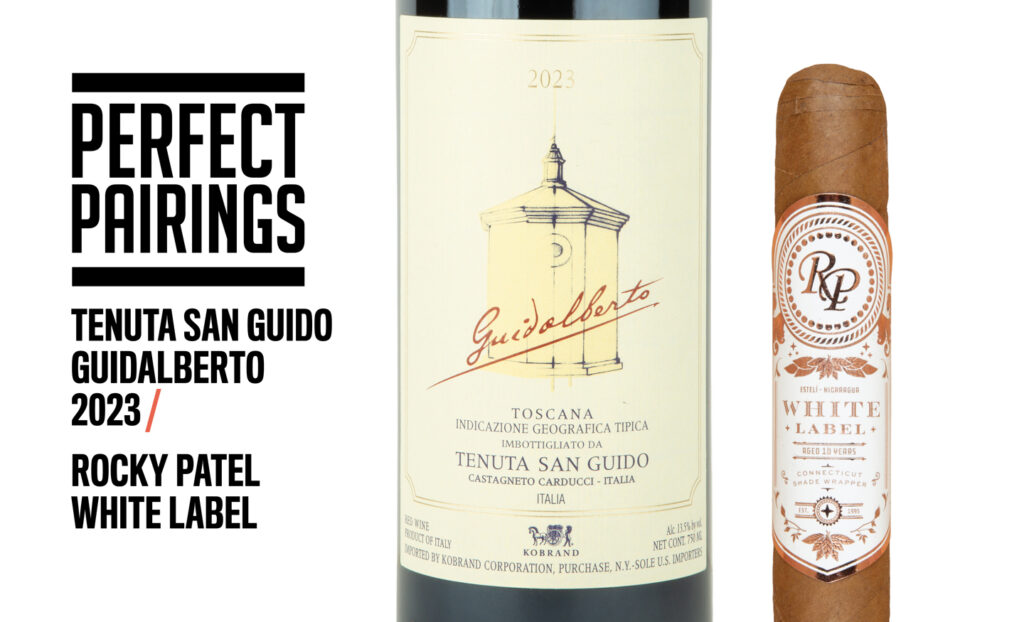
Tasting Notes: Tenuta San Guido Guidalberto 2023
The 2023 vintage in Bolgheri was shaped by a hot August that compressed the Merlot’s ripening window, prompting the estate to shift the blend toward Cabernet Sauvignon, which accounts for 55% of the 2023 Guidalberto against 45% Merlot. The result is a wine with more structure and focus than recent vintages. The nose is of balsamic, raspberry, blood orange, and Mediterranean herbs; the palate is medium-bodied and focused with silky tannins, bright acidity, and a savory, dark chocolate finish.
Cigar Pairing: White Label
The White Label by Rocky Patel provides a perfect accompaniment to the Guidalberto 2023. The cigar is covered with a flawless, light brown wrapper with an elegant, velvet-like wrapper and delivers a beautifully balanced combination of smooth pepper, cedar, and earth accompanied by a touch of citrus on the finish. It is that citrus which makes the pairing shine. The cigar accentuates a note of blood orange in the wine that, joined with the chocolate and raspberry, makes for a dream pairing.