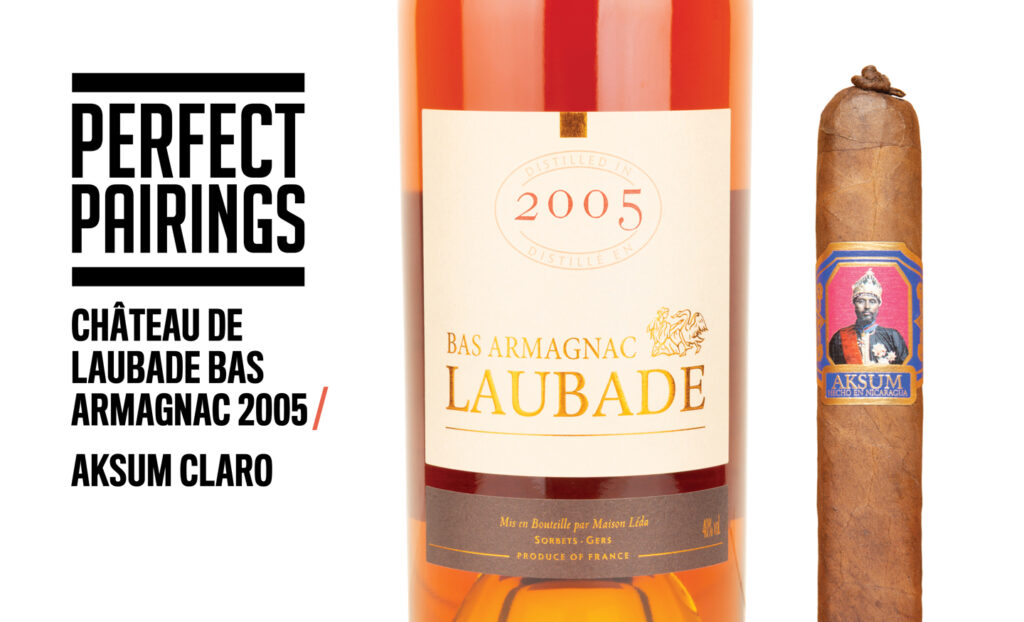
40% ABV
Bas Armagnac
France
Armagnac: France’s Oldest Brandy
While Cognac may be more famous internationally, Armagnac is France’s oldest brandy. Originally valued for medicinal properties, it evolved over the course of a century into a spirit appreciated for its taste.
The biggest difference between Armagnac and Cognac is in their production methods and cultural origins. Cognac developed as a commercial export, while Armagnac remained an artisanal product made by small family operations that preserve ancestral traditions. Their distillation methods differ as well. Cognac is distilled twice in copper pot stills, producing a spirit of about 70% alcohol. Armagnac is distilled once using a continuous column still unique to the region, producing a spirit between 52-60% alcohol that keeps more of the original grape flavors.
Armagnac Regions
Armagnac’s production region is divided into three crus: Bas-Armagnac, Armagnac-Ténarèze, and Haut-Armagnac. Bas-Armagnac is considered the noblest. The secret is in the soil: gentle slopes of tawny sands, sandy clay, and fine quartz sediments stress the vines to produce grapes with concentrated flavors and give the brandy a distinctive elegance.
Château de Laubade: Excellence Across Generations
Château de Laubade was built in 1870 in the heart of Bas-Armagnac, in the village of Sorbets. The estate, with its elegant mansion and 105 hectares of continuous vineyard, has over 150 years of history. Its original owner, Joseph Noulens, was a prominent French statesman. His wife, Jeanne Paquin, was one of the first major female couturiers in Paris, a pioneering fashion designer who built an empire and became the first woman to receive France’s Légion d’Honneur for her contributions to the industry.
In 1974, the Lesgourgues family acquired Château de Laubade and has run it ever since. Today, Denis Lesgourgues leads the estate with his siblings Jeanne and Arnaud, continuing their family’s tradition. Under their leadership, Château de Laubade has received more accolades than any other Armagnac house, earning over 250 awards in global competitions. In 2020, La Revue des Vins de France awarded Laubade “Spirit of the Year.”
Château de Laubade is unique in its vertical integration. The estate owns the surrounding forests and uses local Gascony oak to make all its barrels in its on-site cooperage, the only Armagnac property with one. Every autumn, a herd of 600 sheep from the Pyrenees graze among the vines, producing organic fertilizer in a tradition winemakers have used for centuries.
Distillation takes place immediately after fermentation in an Armagnacais still from 1974. Each grape variety is distilled on its own to preserve its character before blending. The estate’s cellars hold 2,800 barrels, waiting for the perfect moment to be bottled.
Vintage Armagnac: A Single Moment in Time
Unlike most spirits, Armagnac can be vintage-dated, meaning every drop in the bottle comes from a single harvest and distillation year. This practice lets each vintage tell its own story, shaped by that year’s weather, the cellar master’s decisions, and the aging conditions. A 2005 vintage captures a specific moment: grapes harvested in autumn 2005, distilled that winter, and matured in oak barrels over the following years. The angel’s share, the portion lost to evaporation each year, concentrated the remaining spirit while seasonal temperature changes allowed the brandy to breathe and develop complexity.
Pairing by: Erik Calviño
Tasting Notes: Château de Laubade Bas Armagnac 2005
The spirit is pale amber in the glass. The nose offers a rich combination of dark cherry, caramel, vanilla, and fresh white oak with the right amount of heat. The palate has well-integrated tannins with flavors of cherry, brown sugar, fig, and orange zest.
Cigar Pairing: Aksum Claro
The Aksum Claro offers a balanced combination of cedar, smooth pepper, and hazelnut with a touch of lightly roasted nuts. This consistently well-made pressed Churchill is topped with a neat pigtail and draws and burns flawlessly. After a puff, the Château de Laubade loses the heat and zest, resulting in a dessert-like flavor of caramel, brown sugar, and cherry that makes it hard to stop sipping.