40% ABV
Brandy de Jerez
Spain
The Cardinal
Pedro González de Mendoza was born in 1428 to one of the most powerful noble families in Spain. His father was the poet-marquis Iñigo López de Mendoza, and Pedro was the fifth of several children. After studying rhetoric, history, and Latin at the University of Toledo, he earned doctorates in both civil and canon law at Salamanca. In 1452, he joined the court of King Juan II as a royal chaplain. At just 25 years old, he was appointed Bishop of Calahorra, the first of many ecclesiastical titles he would hold.
In 1473 Mendoza was elevated to cardinal. The following year he became Archbishop of Seville, and by 1482 he held the highest ecclesiastical position in Spain. He also served as the chief adviser to Kings Ferdinand and Isabella. His political influence was so profound he was called “the third king of Spain.”
The cardinal’s contributions to Spain extended well beyond politics and religion. Perhaps most significantly for the history of the world, Mendoza was one of the few powerful men in Spain who advocated for Christopher Columbus. He helped convince Ferdinand and Isabella to sponsor the voyage, a decision that would change the course of human history.
Though his life was worldly—he fathered three sons by two different women, as was not uncommon for Renaissance prelates—Mendoza’s charitable works were legendary. He used his vast wealth to build magnificent churches and hospitals, including the Hospital of Santa Cruz in Toledo for foundlings, to which he bequeathed his entire fortune of 75,000 ducats. It’s a fitting tribute that one of Spain’s finest brandies bears his name.
A Family Legacy
In 1781, Juan Sánchez de la Torre founded Bodegas Sánchez Romate Hermanos in Jerez de la Frontera. The bodega grew and prospered, earning appointments as official supplier to the House of Lords in 1909 and the Vatican in 1917. Over a century after its founding, in 1887, the fourth generation of the Sánchez Romate family created an exclusive brandy for family and close friends, naming it after the cardinal who had helped Columbus reach the New World. The brandy was so exceptional it was released to the public, becoming the flagship brand of the house and one of the most recognized Brandies de Jerez internationally.
The Solera System
Spanish brandy makers in Jerez use the solera system, a fractional blending method that creates remarkable consistency and complexity. The word solera means “on the ground” in Spanish, referring to the bottom row of barrels, which contain the oldest liquid. Barrels are stacked in horizontal scales called criaderas, each containing brandy of the same average age. When bottling, producers draw from the oldest scale—never more than one-third from any barrel—then top up with brandy from the next oldest scale, and so on.
For Cardenal Mendoza, the brandy is first aged statically for an average of two years in special 250-liter American oak casks. It is then introduced to the solera system, using 500-liter casks that previously held Oloroso and Pedro Ximénez sherries. The result is a brandy with an average age of 15 years—far exceeding the minimum for the Solera Gran Reserva designation.
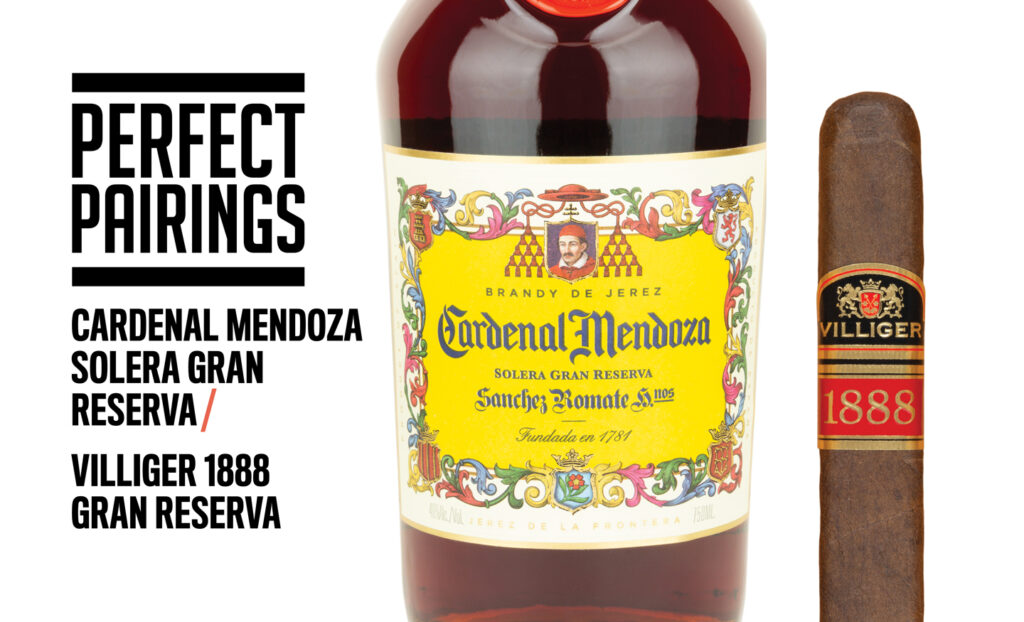
Pairing by: Erik Calviño
Tasting Notes: Cardenal Mendoza Solera Gran Reserva
The brandy displays a dark mahogany color with copper glints. The nose is elegant with rich caramel, toffee, vanilla, and cocoa accompanied by dried fruits—raisins, plums, and dates—along with toasted walnuts and a subtle citrus brightness. On the palate, it’s beautifully balanced and smooth with layers of dark chocolate, caramel, oak, and honey. The finish is long and complex, best savored neat or over a large cube.
Cigar Pairing: Villiger 1888 Gran Reserva
Spoiler alert, this is a fantastic pairing. The box-pressed Villiger 1888 Gran Reserva is an ultra-flavorful toro with a core of earth, mocha, smooth pepper, and roasted almonds on its own. Combined with the Cardenal Mendoza, the smoke becomes thicker, richer, and takes on a unique flavor of earthy caramel.