Cuba between the lines
Ten years ago, Cigar Snob was born as Cuba entered into a new era in its history.
Egberto Escobedo was born and raised in Camagüey, Cuba. It’s his official place of residence on government records. Yet, when he goes home to Camagüey, Egberto is deported — not from Cuba, but from Camagüey. See, he moved to Havana to be with his wife, but he still has family in Camagüey. Sometimes being deported has meant being taken back to Havana. Other times, it’s meant being put in a patrol car and dumped on the highway nearly 200 miles outside Camagüey.
So what did Egberto do to so thoroughly piss off the Cuban government? He’s on the coordinating committee of the Forum for Rights and Liberties, an independent Cuban organization whose name is pretty self-explanatory. The Cuban government doesn’t encourage groups like these. It certainly didn’t appreciate Egberto’s heading into Camagüey with copies of the speech Barack Obama had delivered in Havana during his historic March 2016 visit. He and other dissidents had plans to study the speech closely and figure out what their take would be.
“My wife and I — and activists like us — are the victims of beatings and other mistreatment in the streets and in police stations. In Camagüey, they’ve declared me persona non grata,” said Egberto. “A government official told me that he wouldn’t allow me to go into the province. I have a 22-year-old daughter there who I haven’t seen in three years and he told me I couldn’t see her. I told him, ‘We’ll see.’” At about 1 a.m. the morning of our phone interview, he had been spirited into his own hometown, where he’d hide out at a relative’s home until he was “deported” all over again.
A new chapter in Cuba
Cigar Snob debuted May 20, 2006 (Cuba’s Independence Day). In July of that year, Fidel Castro’s health took a sharp turn and his brother Raul — who had been Cuba’s minister of the armed forces since the regime took power in 1959 — assumed the role of acting president in Cuba. He officially became president in 2008.
Frequent readers of this magazine know we don’t rate or report on Cuban cigars. From the beginning, the magazine’s owners and employees have fielded questions about why that is; the answer is simple. For one thing, those cigars are generally not legally accessible to our overwhelmingly American readership. For another, all those cigars are made by companies owned by the Castros, and the Castros are assholes. Thanks to the fact that the timing of Cigar Snob’s birth coincided with Fidel’s permanent switch from olive green fatigues to Adidas track suits, our history has run in parallel to a new chapter in Cuban history.
… all those cigars are made by companies owned by the Castros, and the Castros are assholes.
Almost immediately, speculation began as to whether Raul would — even if only out of necessity — rule as a reformer.
“In the economic sphere, when Raul Castro took over from Fidel Castro nearly 10 years ago, he began introducing a series of small reforms in the economic domain,” said Dr. José Azel, a scholar at the University of Miami’s Institute for Cuban and Cuban American Studies. “One of those reforms was to allow a certain amount of self-employment in precisely 171 activities. They have now been expanded to something like 206 activities, but they’re all domestic activities. None of them have anything to do with the external sector, and they are trades such as repairing cigarette lighters, selling fruit, repairing umbrellas, and things like that.”
Self-employed Cubans are referred to as cuentapropistas. The categories of independent work in which Cubans can legally engage are as narrow as the examples José listed. You can obtain a license to sell fruit on the street, but you’ll technically need another license if you’re going to also make your living peeling fruit, he said.
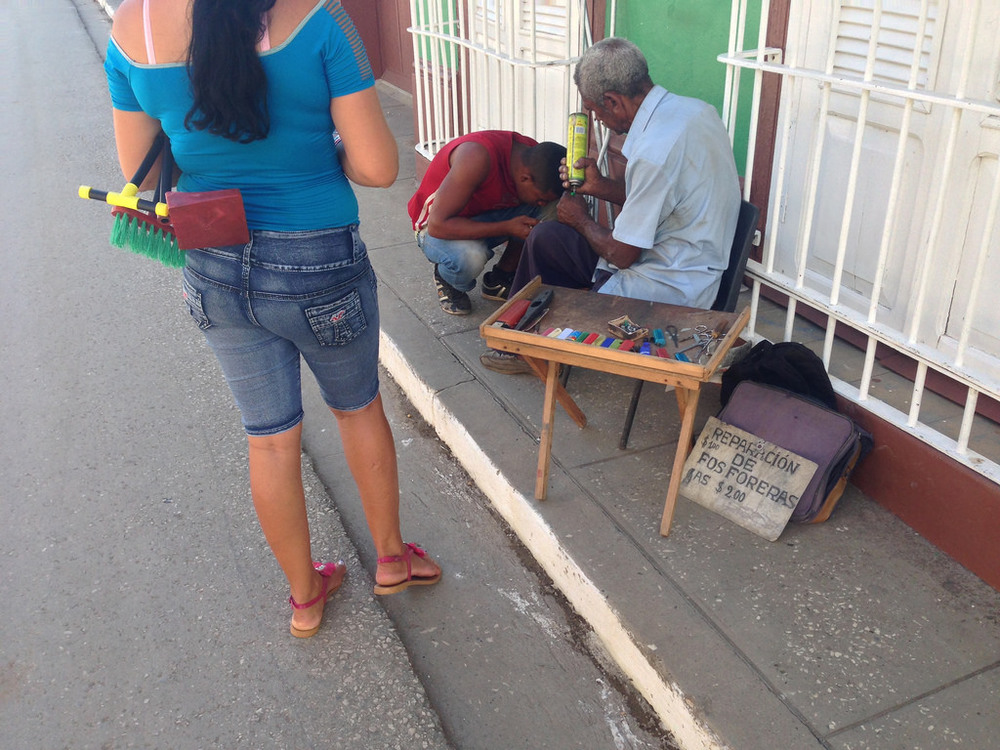
“This is not a private sector as we understand that term in the United States — you know, sole proprietorships, corporations, partnerships and the like. These are individuals that have been granted a permit by the state. They don’t have the kind of legal standing that we associate in the West with the private sector,” said José.
They’re limited, but the changes have made a difference in some Cubans’ lives — albeit a small one compared to how they’d benefit from even freer markets. Egberto is skeptical.
“Over the 56 years this regime has been in place, it has on various occasions freed the market in order to lift the economy. They know free market measures develop the economy. And every time they do it, they later begin to undo the freedoms they had allowed because they are afraid of losing economic control over individuals,” said Egberto. “I don’t think they’ll change their politics; their system survives thanks to totalitarian control of the market. We’re in a time of crisis, and they’re allowing people to be self-employed because the government can’t provide jobs. As they begin to recover economically, they’ll scale back those freedoms.”
Another important change Cuba has undergone is the abolition of its “white card” system. Until 2013, Cubans with valid passports needed what amounted to a trip-specific exit visa in order to leave their own country, a clear violation of the Universal Declaration of Human Rights, of which Cuba is a mocking signatory.
“If the world’s six billion inhabitants could travel any time they wanted, the jam there would be in the skies of the planet would be enormous,” said Ricardo Alarcón with a completely straight face in a forum in 2008. At the time, he was president of Cuba’s National Assembly (the country’s legislative body). He’d been asked to explain the logic behind the white card absurdity.
When white cards were done away with, Cubans who had been denied permission to travel took full advantage. One of them, blogger Yoani Sánchez, who has been named one of TIME Magazine’s Most Influential People in the World, has been traveling persistently, whereas just a few years ago she’d been unable to leave despite countless invitations to accept awards, give lectures, and sit on panels about Cuba. She and others are rushing to get all this travel in before the Cuban regime changes its mind. There’s concern about the decision being reversed or — more realistically — passport renewals being denied to those who the Castros prefer not to see challenging the government’s narrative abroad.
The thaw
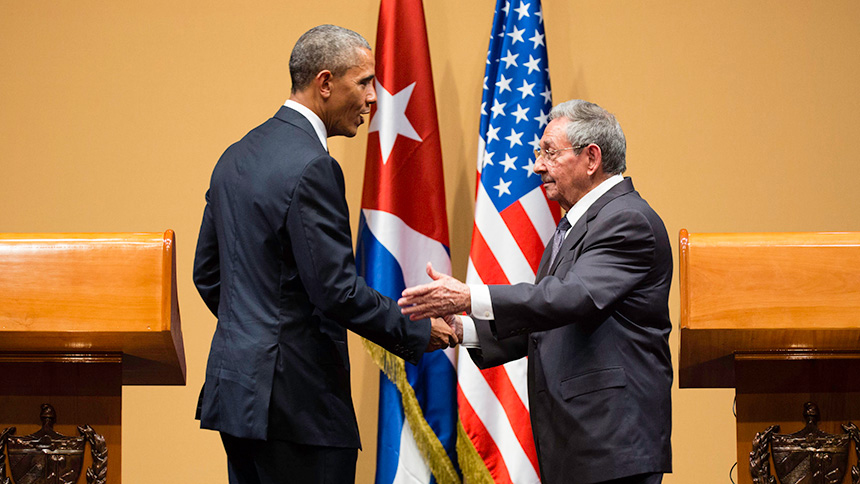
A little more than a year before Cigar Snob’s first issue, Barack Obama was sworn in as a U.S. Senator. He won the presidency in 2008 and has been as much of a game changer for Cuba as Raul. Under Obama, U.S.-Cuba relations have changed as much as could be expected without Congress lifting or altering the embargo. Diplomatic ties have been almost completely normalized, with each country’s interest section becoming a full-fledged embassy. Restrictions on American travel to Cuba have been loosened.
Though Cuba had begun to allow its citizens to own certain consumer tech, Cuba’s unchanged totalitarian core was revealed in 2009, when USAID contractor Alan Gross was arrested in Cuba for delivering satellite and computer equipment to Jewish communities. Ricardo Alarcón (champion of air traffic control) accused him of working for American intelligence agencies and Alan ended up in prison for “acts against the independence and territorial integrity of the state” until a controversial 2014 prisoner swap.
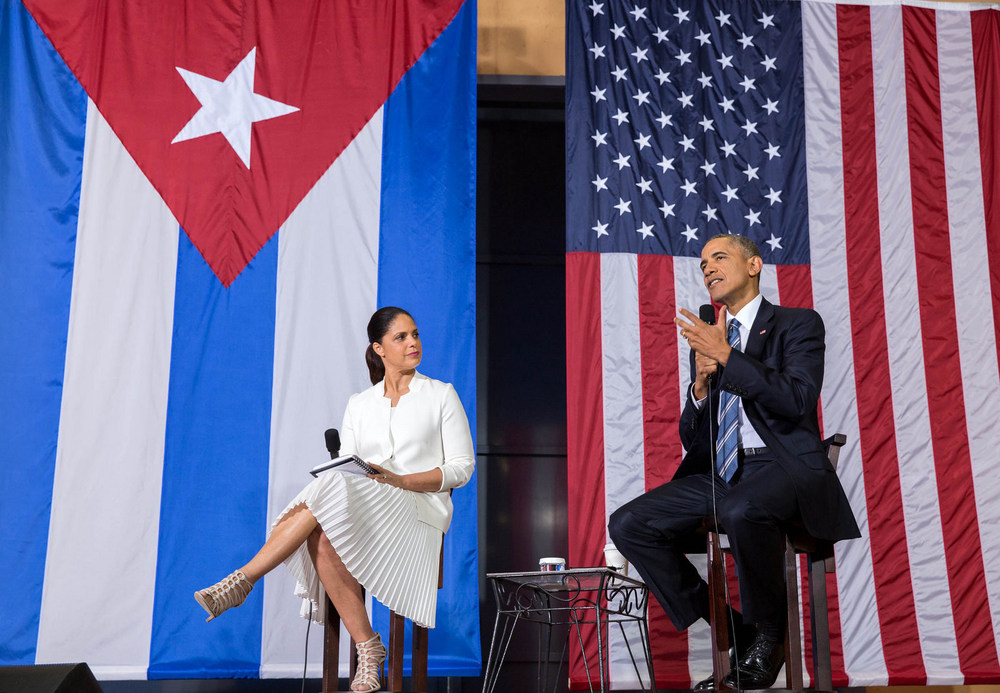
The thaw in U.S.-Cuba relations continues to evolve, but it’s hard to see any moment eclipsing Barack Obama’s visit to Cuba in symbolic significance. It’s easy to find glowing reviews, though, so let’s go to Egberto for another take.
“His visit was a fiasco,” said Egberto. “The Cuban government is capitalizing on it abroad as a tool to undo limitations imposed on it. These people have more experience than Obama does and know how to neutralize his efforts. They’ve begun to make life harder for cuentapropistas with higher taxes. Eventually, you’ll only have a small number and they will be controlled by the regime. That’s not freeing the market.”
The scenario Egberto describes — in which the Cuban government closes doors shortly after opening them — has played out before. Today, travelers to Cuba enjoy paladares (private restaurants usually run out of homes) and stay in casas particulares (think sharing economy lodging, a la Airbnb, without the software). Those businesses only came out of the black market shadows in the mid-90s, during Cuba’s “Special Period.” At the time, Cuba’s extreme poverty couldn’t be helped by the Soviet Union (which had just collapsed) or Venezuelan oil money (Hugo Chávez wasn’t around yet). The U.S. embargo was in full effect — no exceptions for cash-up-front trans- actions, food or medicine. As conditions worsened on the island, the people’s protest for freedom grew louder, peaking in August 1994. In response, Cuba began to allow paladares, but then raised taxes on them in February 1996 and stopped issuing new licenses altogether that April. They even cracked down and shuttered independent restaurants that had become direct competition for government- owned establishments. Baruch College professor Ted Henken wrote that at least one paladar owner he interviewed in Havana saw her licensing fees go up from $23 to $775 in a six-year span. The average Cuban salary is about $20 a month. That’s pushed lots of people back into the black market. I know; I’ve eaten at a clandestine paladar. The shrimp was delicious. It’s also worth pointing out that licenses to for paladares and casas particulares allow their owners to cater either to Cubans or to foreigners, effectively creating an apartheid system against the country’s own citizens.
Cuba has made similar moves in agriculture, the arts, and other areas. So what should Obama have done differently to ensure the change that took place while he was in the White House was more durable?
“Obama should have met publicly and openly with Cuban opposition leaders. Not the way he did: in an embassy office, hidden from the press,” said Egberto. Obama wasn’t quite hidden, but it’s true that his meeting with some of Cuba’s most prominent dissident voices had a decidedly diminutive quality to it that contrasted with the visible nature of his speech at the Teatro Nacional, his attendance at a baseball game with Raul Castro, or his sightseeing jaunt through Havana. There were cameras at the meeting, but it seemed like a slapped-together affair and was, indeed, crammed into a tiny space at the very large U.S. embassy. Case in point: you probably didn’t know that meeting even happened.
Obama should have met publicly and openly with Cuban opposition leaders. Not the way he did: in an embassy office, hidden from the press
Egberto Escobedo
Among the 13 dissidents present at that meeting with Obama: José Daniel Ferrer, the head of Unión Patriótica de Cuba (UNPACU); Guillermo Fariñas, best known for activism for unrestricted Internet access; Berta Soler, the leader of the Damas de Blanco (Ladies in White), who attend Mass every Sunday before silently marching through Havana demanding the release of political prisoners; and Antonio Rodiles, the founder of Estado de Sats, an independent Web series in which Cubans discuss everything from art to economics. Berta and Antonio were in the minority who actually told Obama that he should have stayed in Washington.
“For people to find out what was said in that meeting with some opposition leaders, those leaders practically had to call separate press conferences in other places to tell people about it,” said Egberto. “The Obama administration should have been more critical and less fearful. And he should have done more to ensure that the details of his trip were made known in Cuba, not just outside of Cuba.”
Crack in the dam
“Once this stuff really starts happening in Cuba, it’s going to go like light speed,” said Matt Brady, who has years of experience in democracy promotion and studying government transitions. “Once there’s a crack in the dam, the water is just going to gush. And there’s nobody — not the Cuban government, not the U.S. government — that is going to be able to stop the flood that is going to happen.”
Matt is well versed on the subject of Cuba. He has years of experience in democracy promotion work in that country with Freedom House and the Foundation for Human Rights in Cuba. But the dam metaphor only relates to money flowing into and out of Cuba. Whether that dam’s bursting will have implications for political freedoms and human rights is a big question mark.
“Once you tell Americans they can go to Cuba, they’re going to go in hordes whether you want them to or not,” Matt said. “Once you allow companies to set up cell towers or airlines to establish roots, they’re going to expect to lose money for one to two or three years, hoping that they’ll end up with a pole position for a monopoly or something close to a monopoly. That’s the jockeying that’s happening with the hotels and the airlines.”
Once you tell Americans they can go to Cuba, they’re going to go in hordes whether you want them to or not.
Matt Brady
While there’s disagreement on whether this was the ideal path for the relationship between the American and Cuban governments, just about everyone has come to terms with the idea that the travel and trade restrictions loosened by Obama won’t be tightened any time soon. So what does that mean for people on both sides of the Florida Straits? For one thing, at least some amount of American investment will continue in Cuba. Companies like Carnival, American Airlines, Airbnb, Netflix and Sprint will continue to pump money through the crack in the dam Matt described. Either until the dam will break, leaving them in a great position, or the cracks will be patched by Cuba’s communist government, leaving American businesses on one side and their money on the other.
“Companies know they’re going to lose money for a bit, but they essentially are going to set themselves up and there’s nothing that the government can do,” said Matt, “unless they start seizing assets again [in Cuba], which is possible. You could have that. You really could. That’s the X factor.”
Matt laughed at the idea. What else can you do? After all, this is the same regime that nationalized billions of dollars’ worth of American assets when it first assumed power. And it’s still the case that foreign ventures in Cuba must be owned in partnership with the Cuban government. That can be a dangerous proposition, especially since Cuba’s tourism industry and other sectors that interact with the outside are controlled by the military.
In the cigar world, we have a recent example of the hazards of investing on the island. Cigar Rings prints a large number of the cigar bands you see every time you walk into a cigar store. Its owner Albert Montserrat ended up in the Dominican Republic when he moved there from Havana about 10 years ago. He’d gone to Cuba from Spain thinking he’d find a stable opportunity printing labels for Cuban cigars. It wasn’t too long before he gave up on the Cuban government pulling its weight in the partnership. He was essentially forced to cut his losses and leave. In Cuba, there’s nobody to complain to or sue. You just lose.
“Let’s consider the seventh congress of the Communist Party that closed [in April],” said José Azel, referring to the meeting of Cuba’s Communist Party officials in which Raul Castro was elected to another five years as the head of the party. The first such congress was held in 1975. “Raul Castro and all the Cuban leadership and even Fidel Castro made an appearance to make absolutely certain — so there would be no misunderstanding — that there is not going to be a change in Cuba’s economic or political models.
“The purpose of economic activity [in Cuba] is not to enrich anyone, and in fact when people talk about the Chinese model, when Deng Xiaoping introduced economic reforms in China, which were far more extensive and profound than the economic reforms in Cuba, Deng Xiaoping made the statement that to get rich is glorious. He was trying to change the mindset,” said José, addressing the enormous communist country that so many people point to when drawing comparisons on everything from U.S. diplomacy to the prospect of gradual political and economic reforms. “Raul Castro has made the statement that the accumulation of wealth will not be allowed.”
José thinks it’s more likely that Cuba, years down the road, could come to resemble what he called the “kleptocracy” of Putin’s Russia, in which the old guard of the military and KGB took roles as captains of industry.
“You’re going to have an oligarchy,” Matt said. He also sees Russia as being the best place to go for a look at what Cuba’s economic and political sphere might become, albeit way down the road. “Fidel and Raul in particular have developed these state-owned companies that control large sectors — tourism, foreign exchange, banking. The money from the outside is going to flow into these companies and people that are in charge of them are going to pillage the companies. That’s already started happening. How will the Cuban people react?”
The more things change

Plenty of people are more optimistic about Cuba’s future. Even Matt describes that Russian-style oligarchy as a step toward something more free, more fair. But it’s important to face the reality that having an embassy in Cuba and seeing an American president touch down in Havana are not sure signs that significant or lasting change is happening in Cuba. In fact, while Barack Obama was in the air on his way to Havana, dozens of members of the Ladies in White were arrested during their weekly march. There’s little indication that any of the economic openings translate into a Cuba where people have political freedoms, an independent press, or a government that can go more than a week without beating peaceful protesters in the street. Case in point: Cuba’s National Commission for Human Rights, an independent (and, therefore, illegal) organization that tracks human rights violations on the island, reported that the Cuban regime had made at least 1,380 arbitrary political arrests in the month of April alone, bringing the 2016 total to at least 5,351.
So these half-baked changes — which have had bigger implications for foreign investors, tourists and Cuban officials than for the average Cuban — leave us at Cigar Snob and you, the smoker, with things to think about. What should our relationship with Cuba look like, as a publication and as individuals, and what should be prompting us to change that relationship?
Here is just some of the video of the arrests that took place while Air Force One was on its way to Havana.
“I’d suggest that people who visit Cuba try to create their own agenda for the trip,” said Egberto of what he thought travelers should keep in mind while in Cuba. “They should try to carve their own path inside of Cuba, independently. If you’re taken by the hand to specific locations (chosen by the government), you’re not going to get to know the real Cuba. When you see what the government wants you to see, you might think, ‘They’re on the right path.’ It’s a lie. But Cuba is not only coffee, tobacco and rum. If our economy is freed, if private enterprise is allowed, Cubans are creative enough to create great things in a way that is sustainable.”
I know from experience that Cuba’s government manipulates travel experiences to preserve the facade. In 2009, I was turned away at José Martí International Airport. A security agent told me that I was not allowed into “any part of the country,” then escorted me back to the Mexicana Airlines plane that had taken me to Cuba and had me board. No boarding pass, no interrogation, no air marshal. Just an arbitrary, extrajudicial determination that I was too dangerous to let in. It probably had something to do with all the dissidents, underground journalists and artists I had met with during previous trips.
In fact, the U.S. embassy in Cuba recently said Cuba’s government has a practice of treating American citizens who were born in Cuba as Cuban citizens while they’re visiting the island. In other words, Cuba doesn’t recognize the rights and legal protections that Cuban natives would enjoy while returning to the country of their birth. This is clearly meant to intimidate the travelers most likely to spread subversive ideas.
Even non-Cubans can feel it. In December 2015, filmmaker and YouTuber Casey Neistat posted video commentary about his own trip to Cuba. “I was there as part of a technology delegation,” he said in one of his vlogs. “We were supposed to meet with our Cuban counterparts and discuss technology and what it could do. The Cuban government actually stepped in at the last minute and said no to a lot of the things we wanted to do and a lot of the things we wanted to discuss. And a lot of what we were there to do was compromised. They dictated the terms of what turned out to be a very boring panel that should have been interesting. This idea that a government can tell you what you can and cannot say is something that I know nothing about.”
Especially if you’re traveling to Cuba as part of a tour group, it’s unlikely that you’re getting an unfiltered view of what life is like there. Hamlet Paredes, who joined Rocky Patel to create his own cigar brand, Tabaquero, arrived in the U.S. a little more than a year ago from Cuba, where he was one of the cigar industry’s star cigar rollers and ambassadors (which is at least part of the reason he speaks such good English). He still has family in Cuba, and he’s more optimistic than Egberto is about the impact of Obama’s diplomatic efforts. That said, he has some similar takes on how travelers to Cuba should approach their visits.
“It depends on the objective of each traveler. When I visit a new country, I like to get to know its people and see its reality. Most tourists are in a fishbowl and they’re shown everything that paints the country in a positive light. Meanwhile, they’re walking right by the reality and don’t even see it,” said Hamlet, adding that eating at paladares is one way to get a closer look at the lives of ordinary Cubans.
Those opportunities to engage with Cuban cuentapropismo are more limited if you’re planning a cigar-centric trip. None of the limited categories in which Cubans can run licensed businesses involve making cigars or growing tobacco, for example. For the foreseeable future, Cuba’s cigar industry will be monopolized by Habanos, which markets every cigar manufactured there. Even if Cubans were allowed to open independent boutique factories tomorrow — which is highly unlikely since the Cuban government has no interest in creating competition for its cash cow — it would take a long time for Cubans to build the skill sets necessary to compete.
“There are things we’re not used to,” said Hamlet. “I’m still learning to do things like negotiate. Those are things I never had to do in my country because everything is so tightly directed by the state. That kind of thing will happen to those who go into business for themselves.”
In the meantime, we at Cigar Snob will be anxiously awaiting substantive change in Cuba. God willing, we’ll be reviewing independent brands produced in small, independent Cuban factories.
Editor’s note: The story above appears as it did when it ran in the print edition of Cigar Snob Magazine. Shortly after that issue shipped, it was reported that Cuba would be “legalizing” small- and medium-sized businesses. What exactly that means and how it will impact Cubans — especially in the long term — is unclear, especially considering that the country is still ruled according to a constitution that (among other things) gives the state the ability to legally lay claim to any property it wants.